
JBL Clip 5 Review: Tiny Speaker, Big Attitude
The JBL Clip 5 is an ultra-portable Bluetooth speaker aimed at people who want legitimate sound without hauling a tote bag of gear. If you want something you can clip to a backpack, belt loop, or water bottle and expect clear music for a full day out, this is the kind of product you are looking at. The Clip 5 promises portable JBL Pro sound, up to 12 hours of playtime with an extra boost option, and an IP67 water and dust rating.
Pros
- Compact integrated carabiner that opens wider than prior models, making attachment easier for active use.
- Up to 12 hours battery life with an additional Playtime Boost of roughly 3 hours when engaged, so it will last most daytime outings.
- IP67 waterproof and dustproof rating for poolside, beach, or rain-ready listening.
- Bluetooth connectivity with Auracast support for multi-speaker pairing and stereo pairing options.
- Made in part with recycled materials and certified recycled content, which is a clear plus for eco-minded shoppers.
Cons
- Small physical footprint means bass and maximum loudness are limited compared with larger portable speakers; power output and driver size reflect a compact design.
- No built-in power bank function, so you cannot charge other devices from the speaker.
- Physical buttons may require care over the long term if tossed in a bag with other items.
- Single-driver form factor restricts the spatial soundstage compared with multi-driver models.
Pocket-Sized Power
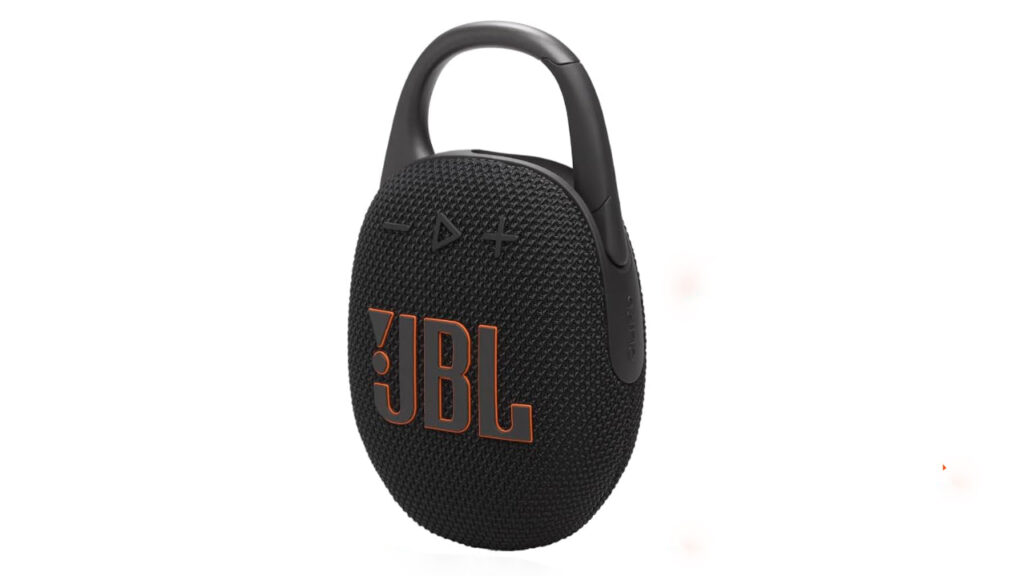
Image credit: JBL
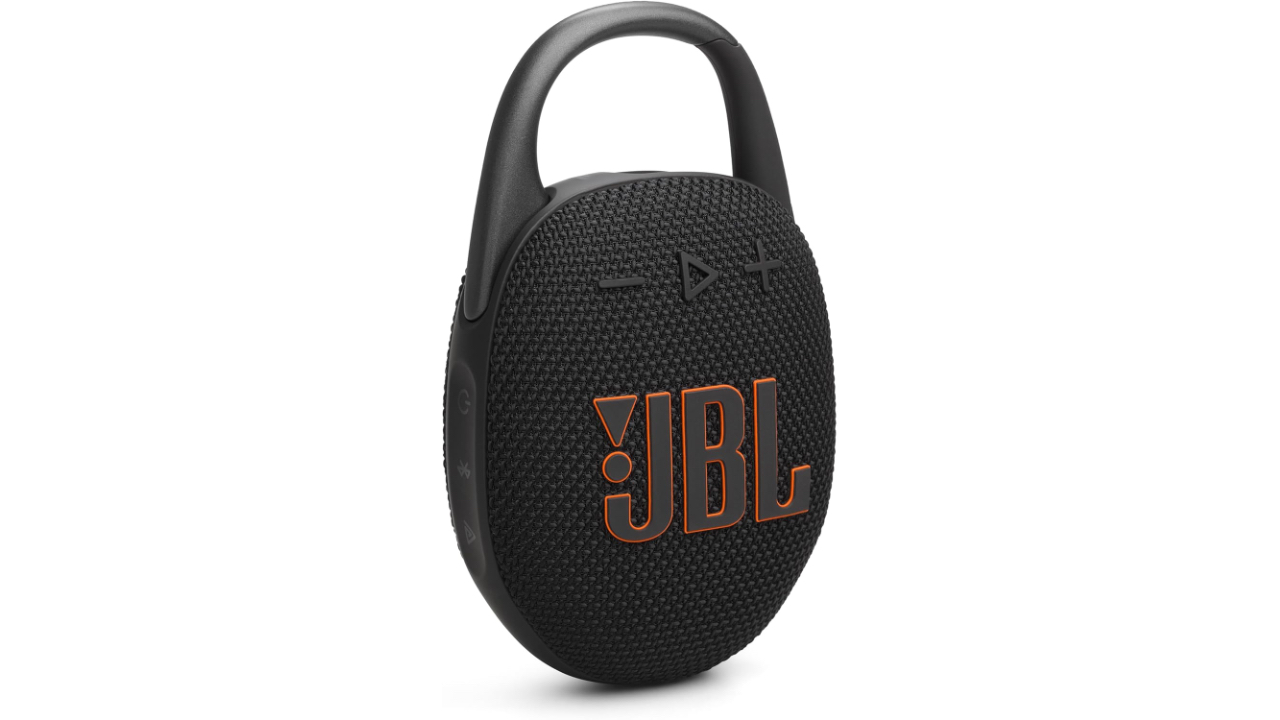
The Clip 5 emphasizes portability first. It measures roughly 3.4 inches wide, 1.8 inches deep (thickness), and 5.3 inches high, weighing about 0.29 kilograms, so it slips into a small pocket or hooks neatly to outdoor gear. That integrated carabiner is redesigned with a wider opening for faster clipping to straps and loops. The physical measurements and weight make the Clip 5 one of the more genuinely pocketable speakers in the JBL lineup.
Beyond size, JBL positions the Clip 5 as an “ultra-portable” speaker delivering JBL Pro Sound with punchy bass. The speaker uses a compact 45 mm (about 1.77 inches) driver and a single enclosure, prioritizing clarity and balanced output over multiple-driver complexity. That driver choice keeps things simple for users who want an easy plug-and-play experience without fiddling with EQ or crossovers.
Included in the package is the Clip 5 itself, a USB-C to Type-A charging cable, a quick start guide, and the warranty card. The unit is battery powered with an input voltage of 5 volts which aligns with common USB charging sources. These simple inclusions mean you can charge it from a power bank, wall adapter, or laptop and be ready to go without buying extras.
Splash, Dust, and Rough Days

Image credit: JBL
The Clip 5 carries an IP67 rating for water and dust resistance. In practical terms that means the speaker is rated to withstand immersion in up to 1 meter of water for a short time and is fully protected against dust ingress. For anyone who plans to use this at the pool, on rainy walks, or on a sandy beach, that rating reduces anxiety about light abuse and typical outdoor exposure. The IP67 rating is a more robust protection level than the common IPX7 water-only ratings, because it includes dust sealing.
JBL also highlights durability through materials and a plastic construction that balances weight and toughness. The exterior is designed to be grippable and the integrated carabiner sits as part of the body rather than added on as a clip. That integration reduces snag points and eliminates the common annoyance of a detachable clip failing or getting lost during travel.
Because JBL lists recycled materials certification for this product, buyers get both durability and a measure of sustainability. The product includes recycled content certified by SCS Global which indicates a minimum threshold of recycled material used in the unit. For buyers who track environmental footprint, that certification is a concrete data point to weigh alongside the Clip 5’s lifespan and replaceability.
All-Day Tunes Without the Tether

Image credit: JBL
Battery life is a headline spec. JBL quotes up to 12 hours of continuous playtime on a single charge and offers a Playtime Boost feature that can add approximately 3 more hours when activated. That gives a practical ceiling of about 15 hours in the right conditions when you use Playtime Boost. These numbers put the Clip 5 well within the range needed for a beach day or a long commute and mean fewer mid-day charges for typical users.
For wireless connections, the Clip 5 supports Bluetooth with Auracast functionality which enables pairing multiple Auracast-enabled JBL speakers or pairing two Clip 5 units for stereo sound. Auracast and Bluetooth V5.3 bring more stable connections and lower-latency headroom than older Bluetooth generations. The connectivity choices make it simple to expand sound or link speakers for a broader soundstage when needed.
Charging is via USB-C at a 5 volt input which aligns with modern charging standards and keeps cable fuss minimal. The lack of a power bank feature may disappoint users who hoped to top off a phone from the speaker, but the USB-C charging itself is convenient and quick relative to legacy micro-USB solutions. The included cable covers the basics for immediate use out of the box.
What To Expect from The Sound
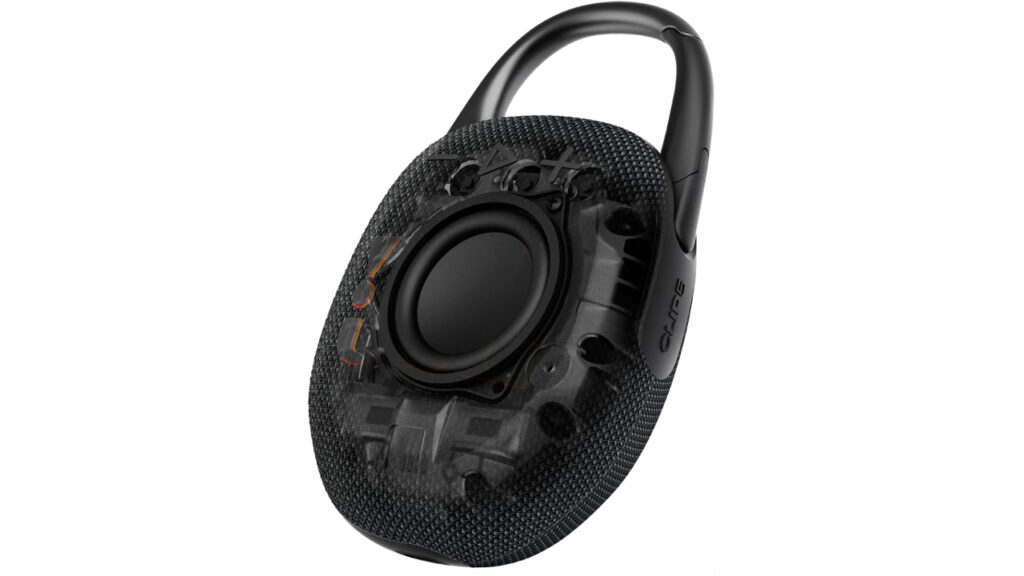
Image credit: JBL
The Clip 5 is built around a compact single 45 mm driver with a modest RMS power rating appropriate to its size. JBL lists platform power output aligned with other small portable units in the family and a single speaker design focused on clarity over room-filling SPL. Expect clear mids and punchy upper bass for personal listening and small-group settings. The sonic profile is tuned for everyday listener tastes rather than audiophile flatness.
Because of the small driver and compact enclosure, low-frequency extension will be limited compared with larger battery speakers. For users who prioritize deep, room-shaking bass the Clip 5 will not substitute for a Flip, Charge, or larger boombox style speaker. Where the Clip 5 shines is in delivering balanced volume and clarity at close range and in outdoor ambient environments where weight and packability are decisive.
The ability to pair two units for stereo or to add Auracast-enabled devices for multiple-speaker playback gives buyers flexibility to scale sound while keeping the base unit pocketable. In short, the Clip 5 ought to satisfy listeners who want true portability with clear sound and usable bass for on-the-go listening rather than home stereo replacement aspirations.
Life on the Go
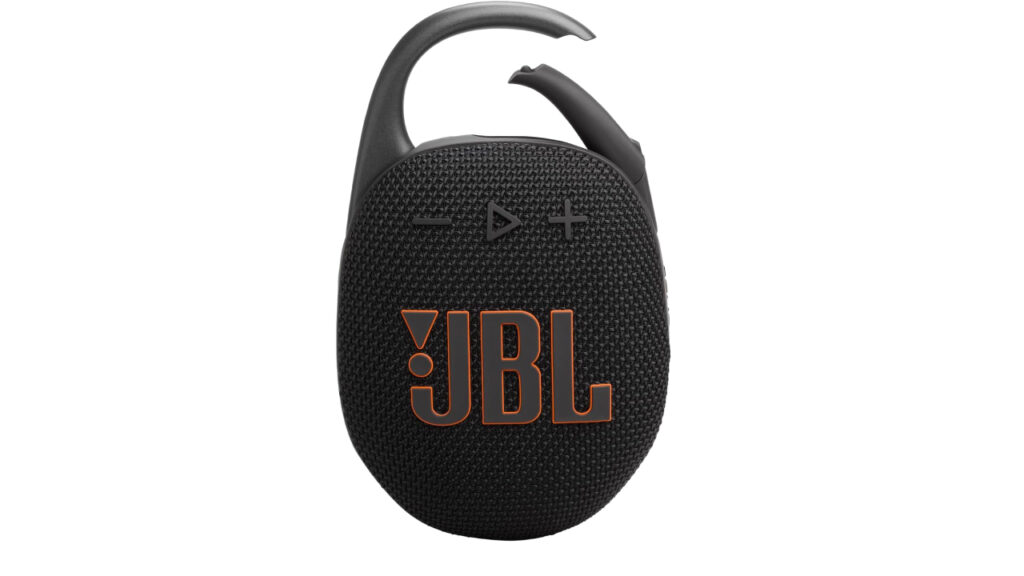
Image credit: JBL
Setup is straightforward: power on, enable Bluetooth on your source device, and pair. The speaker is compatible with common devices including smartphones, tablets, laptops, and other Bluetooth-enabled sources. The Clip 5 uses raised physical buttons for playback, volume, power, and Bluetooth pairing, so there are no touch-sensitive controls to worry about. That simplicity ensures walk-up-and-play convenience.
Storage and portability are a core value proposition. The integrated carabiner keeps the unit clipped and accessible, which reduces wear from digging into bags. However, the exposed buttons and ports mean you should avoid stuffing the speaker into the same pocket as keys and coins. Even though the IP67 rating protects against dust and splashes, mechanical knocks and repeated abrasion could eventually affect finish and ports.
The Clip 5 is not a power bank and it does not include wired line-in. It also runs a single-driver layout, so if you need long-term household use as a primary speaker for parties, a larger model may be a better fit. For hikers, commuters, and casual outdoor listeners who want a reliable compact speaker with a respectable battery life and waterproofing, the Clip 5 is a practical and portable option.
Conclusion: Should You Buy the JBL Clip 5?
If you want a genuinely pocketable speaker with a wide-opening integrated carabiner, IP67 protection, around 12 hours of runtime plus a Playtime Boost option, and Auracast-capable Bluetooth pairing, the Clip 5 is worth strong consideration. It is not a home stereo replacement but it is well suited to hikers, commuters, and anyone who values convenience and weather resistance over maximum loudness. If you need deeper bass, higher sustained volume, or a speaker that doubles as a power bank, look at larger models instead.