
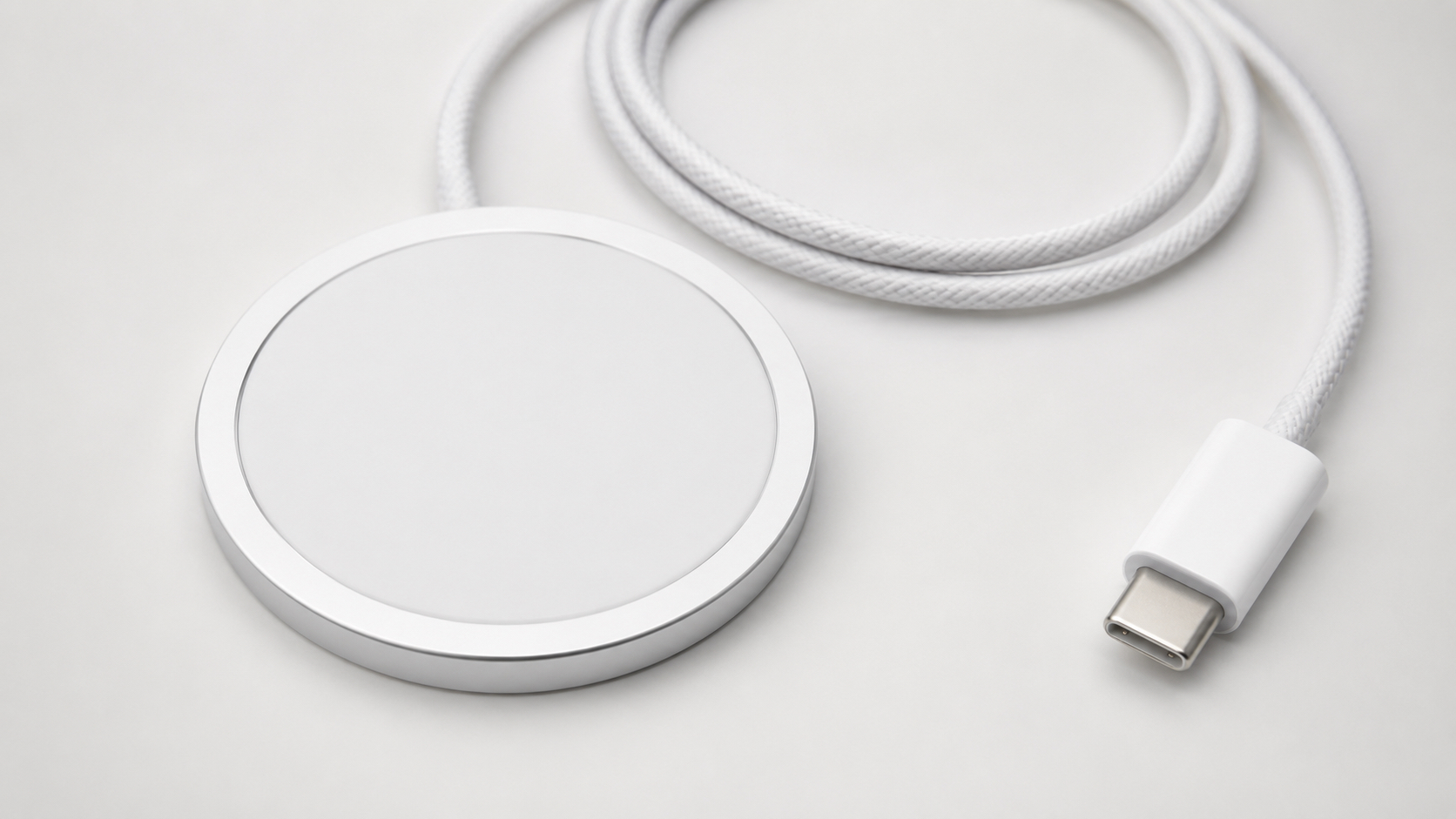
Apple MagSafe Charger Review: The First-Party 25W iPhone Puck
The Apple MagSafe Charger brings up to 25W wireless charging to supported iPhones in Apple’s familiar slim magnetic puck. It is peak Apple hardware logic: one clean idea, beautifully reduced, with the wall adapter sold in another box because of course it is.
Pros
- Up to 25W charging with supported devices and adapter
- Qi2 25W and Qi compatibility
- Excellent magnetic alignment on compatible iPhones
- Slim one-meter design with braided cable
Cons
- 30W wall adapter is sold separately
- No stand or Apple Watch charging surface
- Older iPhones and ordinary Qi devices charge more slowly
The Magnetic Connection Remains the Cleanest Part of MagSafe
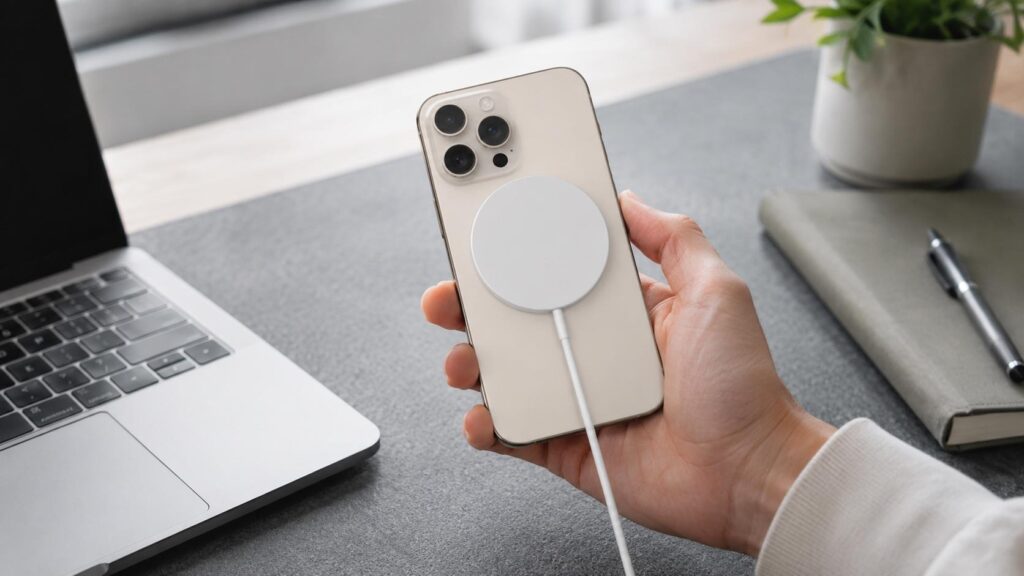
The magnet remains the killer feature because it turns charging from a placement task into a reflex. Apple’s MagSafe Charger attaches to compatible iPhones with a centered magnetic connection, removing the alignment uncertainty of a traditional pad. The puck finds the charging ring, holds itself in place, and begins charging without asking the user to position the phone by eye. That consistency is the accessory’s defining convenience, especially when the phone is picked up and used during charging.
The current one-meter model uses a woven integrated cable and USB-C plug. It is thin enough for a travel pouch and small enough to disappear on a desk, yet the cable gives it more freedom than a rigid stand. The phone can lie flat, rest on another surface, or remain in the hand while the puck stays attached.
Magnetic attachment requires compatible hardware. iPhone 12 and later MagSafe models provide the intended snap, while ordinary Qi devices can charge without the same alignment experience. A MagSafe-compatible case preserves the connection; a thick case, wallet, metal plate, or poorly placed accessory can weaken the magnets or interrupt power transfer. That snap is still the reason MagSafe feels finished while ordinary flat pads feel merely functional.
Twenty-Five-Watt Charging Is Powerful but Conditional
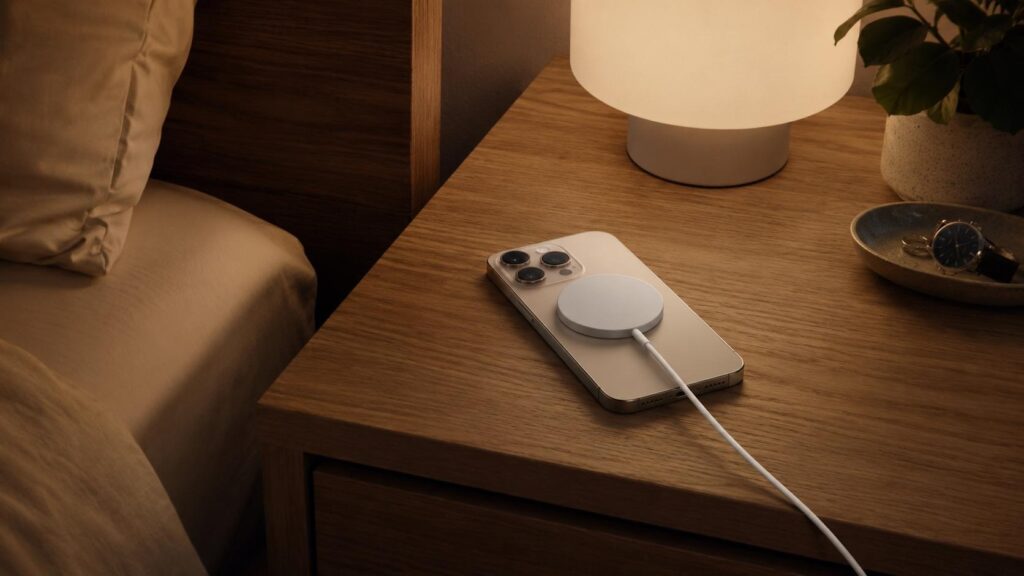
Twenty-five watts is real speed, but it arrives only when the entire chain, from phone to adapter to temperature, is ready for it. Apple rates the charger for up to 25W when it is paired with a compatible device and a 30W USB-C power adapter. Supported newer iPhones can reach that ceiling, while earlier MagSafe models generally top out at 15W and older Qi-capable iPhones may charge at 7.5W. The puck cannot force a phone to accept a profile it does not support.
The 30W adapter is sold separately. That matters because a smaller adapter can reduce the available wireless output even when the phone and puck are capable of more. Buyers upgrading from an older 20W Apple adapter may still receive useful charging, but they should not assume it unlocks the maximum rate on newer devices.
Wireless charging speed also changes during a session. Battery temperature, ambient heat, phone activity, case design, software, and state of charge all influence power. Apple’s fast-charge estimate applies under controlled conditions and should be treated as a best-case reference. A cable remains more efficient when the goal is the quickest possible refill with the least heat. The charger can move quickly, but physics still sends a heat bill.
Qi2 25W Broadens the Puck Beyond a Single iPhone Generation
Qi2 gives this puck a broader future than the original MagSafe accessory had, even though Apple still controls the cleanest version of the experience. The current MagSafe Charger is certified for Qi2 25W and Qi charging. That gives it a broader technical foundation than the original MagSafe accessory, whose fastest behavior was more tightly associated with Apple’s own devices. Compatible Qi2 25W phones can negotiate higher magnetic charging rates, while ordinary Qi products fall back to the profiles they support.
AirPods cases with wireless charging can use the puck, though their small shape does not benefit as dramatically from the magnetic ring. Apple Watch remains incompatible because it uses a different charging system. A household with an iPhone, Watch, and AirPods therefore needs additional cables or a multi-device station.
The open Qi2 direction improves the charger’s long-term relevance, but certification does not make all products identical. Magnet strength, case design, device software, and power-adapter requirements still influence the experience. The strongest reason to choose Apple’s puck is the first-party match with compatible iPhones, not the assumption that every Qi device will charge at the same headline rate. The puck is no longer trapped inside an Apple-only historical footnote; Qi2 turns it into part of a larger charging standard.
Lab Results Show Real Speed and Real Heat
Professional testing gives the 25W MagSafe Charger a clearer performance story than most accessories in this group. In controlled ChargerLAB testing with an iPhone 16 Pro Max and Apple 30W adapter, the phone reached 50% in about 34 minutes and completed a full charge in roughly two hours and 23 minutes. The charger held high input power early, then stepped down as the battery filled, exactly how modern charge management should behave.
That same test recorded surface temperatures around the high-30s to low-40s Celsius during the first 50 minutes. In normal language: the puck and phone can feel noticeably warm. Amazon and retailer owners often praise the speed, magnetic convenience, and first-party reliability, while common complaints focus on the missing 30W adapter, price, warmth, and the occasional defective unit or return headache.
The feedback paints a coherent picture. This is genuinely fast wireless charging for supported iPhones, not a decorative upgrade to the old 15W puck. It is also still wireless charging, which means heat, conversion loss, and a taper near full capacity. Buyers get Apple’s cleanest magnetic experience, but the laws of thermodynamics remain stubbornly cross-platform.
Should You Buy the Apple MagSafe Charger (1 m)?
The Apple MagSafe Charger is the best choice here for supported iPhone owners who want first-party magnetic alignment and access to 25W wireless charging. Its thin shape, braided one-meter cable, and Qi2 25W support make it flexible enough for daily use and travel without surrounding the phone with a large dock. It is expensive minimalism with a measurable speed advantage, the most Apple sentence possible.
Buy it when speed and Apple integration matter more than included accessories. Budget for a 30W USB-C adapter if the phone can use the maximum output. Choose a stand for upright viewing, a three-in-one station for an Apple Watch and AirPods, or a universal Qi pad when several phone brands must share one charger.