
Midea Duo Review for the MAP14HS1TBL Portable Air Conditioner
The Midea Duo MAP14HS1TBL is one of the more interesting portable air conditioners because it does not follow the basic single-hose formula. It uses Midea’s hose-in-hose dual-hose design, variable-speed inverter technology, smart controls, and a heat mode, giving it a more complete feature set than most portable AC units in the same general size range.
For shoppers comparing the best portable air conditioners, the Midea Duo is appealing because it tries to solve the problems that make many portable ACs frustrating: weak efficiency, hot air leakage, loud compressor cycling, and clunky setup. It is rated at 14,000 BTU ASHRAE / 12,000 BTU DOE or SACC and is built for spaces up to 550 square feet, making it one of the stronger portable options for bedrooms, living spaces, apartments, and home offices.
Pros
- Dual hose-in-hose design helps reduce negative pressure and improve cooling efficiency.
- 14,000 BTU ASHRAE / 12,000 BTU DOE cooling rating is strong for a portable AC.
- Variable-speed inverter can run more smoothly and efficiently than basic on/off compressor designs.
- Four modes cover cooling, heating, ventilation, and dehumidifying.
- Wi-Fi, app control, Apple Watch support, and voice assistant compatibility add real convenience.
- Very quiet for its category, with Midea listing operation as low as 42 dBA.
Cons
- Usually costs more than simpler portable air conditioners.
- Heavier and larger than compact models, so it is portable but not effortless to move.
- Smart features are useful, but some users may still prefer a simpler remote-first setup.
- Like any portable AC, it still needs a properly sealed window installation to perform well.
Smart Features and a Dual-Hose Design That Set It Apart
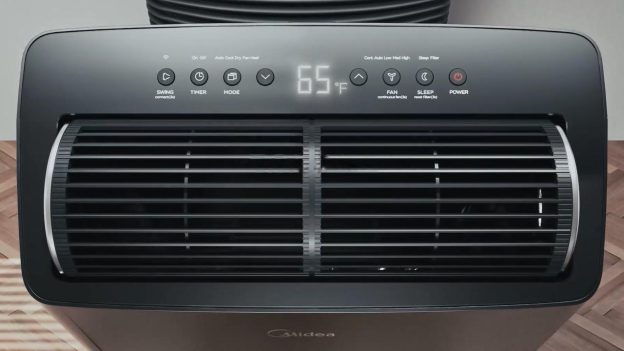
Image credit: Midea
The Midea Duo MAP14HS1TBL stands out because its features are not just add-ons; they affect how the unit cools. The hose-in-hose design combines intake and exhaust pathways in one larger assembly. In practical terms, that helps the unit pull in outdoor air for heat exchange while sending hot exhaust back outside, instead of relying as heavily on already-cooled indoor air. That is one of the biggest reasons dual-hose portable air conditioners tend to perform better than single-hose units in hot weather.
The inverter compressor is the other major feature. Traditional portable air conditioners often cycle on and off more abruptly, which can mean louder operation, uneven temperatures, and more energy spikes. An inverter system can vary output more gradually. When the room is hot, it can work harder. Once the room approaches the set temperature, it can ease back rather than shutting down completely. That makes the cooling feel steadier and can help reduce energy use over longer sessions.
The Midea Duo is also a 4-in-1 appliance: air conditioner, heater, fan, and dehumidifier. The heat mode will not replace a furnace in a cold climate, but it is useful during shoulder seasons, chilly mornings, basements, and apartments where central heat is uneven. The fan mode is helpful when the room just needs circulation, and the dehumidifier mode can make muggy air feel more comfortable even when the temperature is not extreme.
Smart control is more robust than most portable ACs. The unit works with Midea’s SmartHome app, and official listings note app control, Apple Watch control, and voice assistant compatibility. That means the AC can be turned on before heading into a bedroom, scheduled around work hours, or adjusted from the couch without hunting for the remote. The controls on the unit are still clear, so the smart features feel optional rather than required.
A Sleeker Portable AC With a More Thoughtful Setup
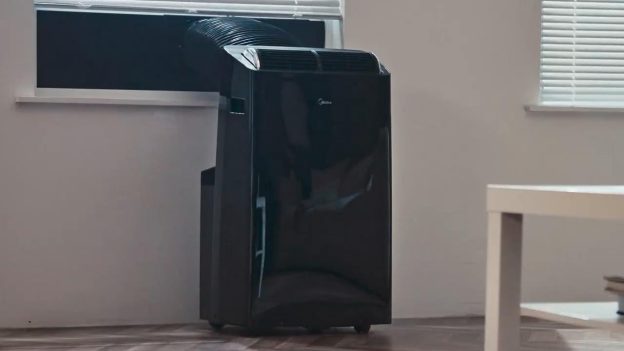
Image credit: Midea
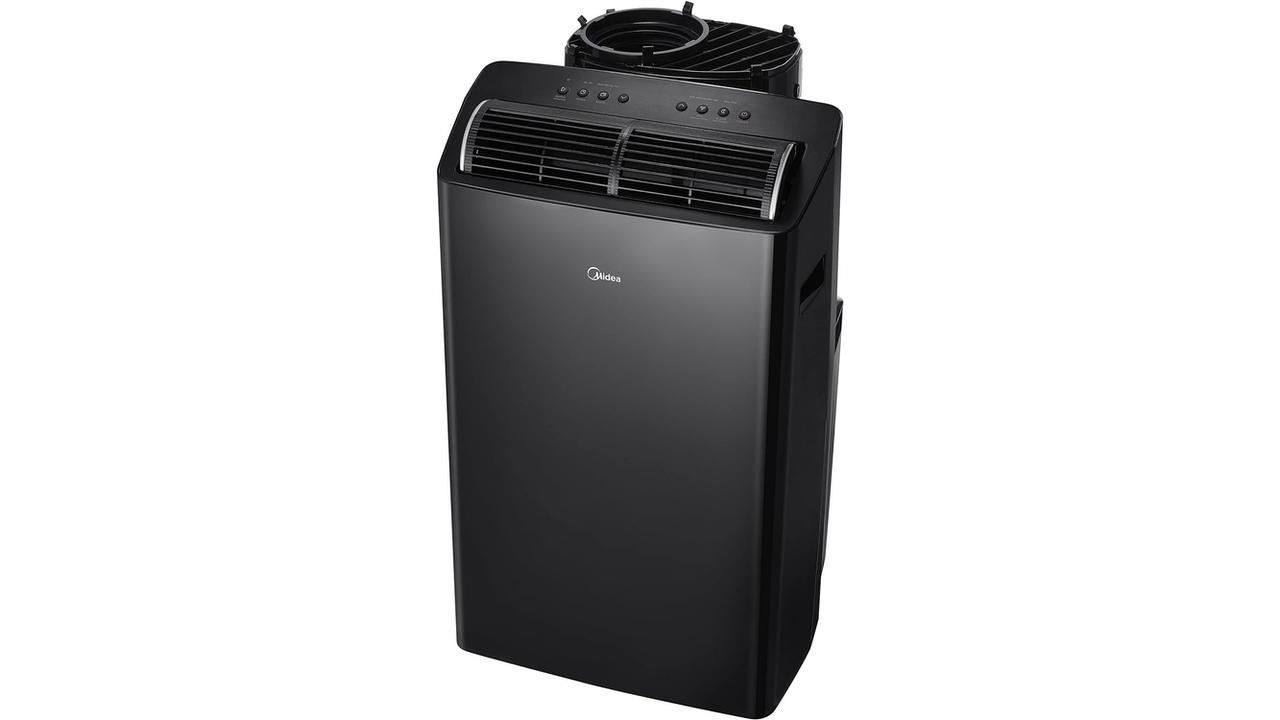
The Midea Duo looks more modern than many portable air conditioners. The black tower design, front air outlet, and integrated hose storage give it a cleaner presence in a room. It is still an appliance, not decor, but it avoids the bulky medical-equipment look that some portable AC units have. The vertical shape also makes it easier to tuck near a window without taking over the entire corner.
The setup is more thoughtful than a basic single-hose unit, though it still requires patience. The hose-in-hose assembly is larger than a standard exhaust tube, and the window bracket needs to be installed carefully. Because this unit is capable of strong cooling, leaks around the window panel matter. Any gap lets warm air back in and forces the unit to work harder. Foam strips, weatherstripping, or a supplemental sealing kit can improve performance, especially with older windows or sliding doors.
At more than 70 pounds, the Midea Duo is not the portable AC to carry around the house every day. It has casters, and it moves well across smooth floors, but it is best treated as a seasonal room appliance. Put it where it will be used most, set up the window kit properly, and leave it there during the hottest weeks. That approach gets the best mix of convenience and cooling performance.
Build quality feels appropriate for the price. The hose design is more integrated than most, the controls feel modern, and the overall package suggests a higher-end portable AC. As with any unit in this category, the vulnerable pieces are usually the window kit, hose connections, and drainage setup. Gentle handling during installation and storage will do more for longevity than any single spec on the box.
Fast Cooling, Quiet Operation, and Inverter Efficiency

Image credit: Midea
Performance is the main reason to consider the Midea Duo over cheaper portable air conditioners. Its 12,000 BTU DOE/SACC rating is strong and more meaningful than the older ASHRAE number for real-world comparison. In a properly sized room, it can cool quickly and maintain comfort without the harsh stop-start feeling common to less advanced compressor units. The airflow is strong enough for bedrooms, apartments, offices, and medium living areas, especially when doors are closed and sun exposure is managed.
Midea advertises energy savings of more than 40% compared with the U.S. federal standard, and while real savings depend on climate, insulation, set temperature, and runtime, the inverter system gives the Duo a genuine efficiency advantage. Instead of blasting at full power and shutting off repeatedly, it can modulate output. That matters most for people who run a portable AC for hours at a time rather than only using it for short bursts.
The noise profile is also better than expected. Midea lists operation as low as 42 dBA, which is very quiet for a portable air conditioner. It will still make sound when the fan ramps up or the compressor works hard, but the tone is smoother than many cheaper units. In bedrooms, that makes a difference. It is easier to sleep through a steady hum than a compressor that clunks on and off all night.
The heating function adds value, but expectations should stay realistic. This is a portable heat pump-style appliance for supplemental comfort, not a full-home heating system. In a mild climate or during fall and spring, it can stretch the usefulness of the unit beyond summer. In very cold conditions, central heat or a dedicated heater will still be the main tool. The Midea Duo is at its best as a high-performance portable climate control unit for one important room.
Drainage, Filter Care, and Keeping the Duo Running Smoothly

Image credit: Midea
The Duo does not ask for complicated maintenance, but it rewards consistency. The washable filter should be cleaned regularly because strong airflow is central to its performance. A dirty filter can make the unit louder, less efficient, and slower to cool. During peak summer use, checking the filter every couple of weeks is a smart habit, especially in dusty homes or homes with pets.
Drainage depends on mode and humidity. In normal cooling, much of the condensate may be handled internally, but high humidity or dehumidifier mode can produce more water. Users should understand the drain ports before relying on the unit overnight or while away. Continuous drainage can be helpful in humid climates or basements. It is not glamorous, but proper drainage is one of the keys to avoiding error codes, shutdowns, or water surprises.
Because the hose-in-hose system is central to the design, seasonal storage deserves some care. Let the unit dry, remove and clean the filter, drain any remaining water, and store the hose assembly without crushing it. If the window kit is removed for winter, keep all adapters and panels together. Losing one small piece can make spring setup much more annoying than it needs to be.
Long-term, the Midea Duo is best for someone who wants a portable AC that feels closer to a permanent climate solution. It is not maintenance-free, but it is not fussy either. Clean airflow, good drainage, and a tight window seal are the big three.
Conclusion: Should You Buy It?
The Midea Duo MAP14HS1TBL is one of the best portable air conditioners for shoppers who care about performance, efficiency, and noise. It costs more than a basic unit, but the dual-hose design, inverter compressor, smart controls, and heating mode justify the upgrade for many households.
This is the right choice for a primary bedroom, apartment living room, home office, or any space where a portable AC will be used often. It is heavier and more expensive than entry-level models, but it also feels more capable and refined. If the goal is to buy one portable air conditioner that can handle serious summer heat without sounding like a shop fan, the Midea Duo belongs near the top of the list.