

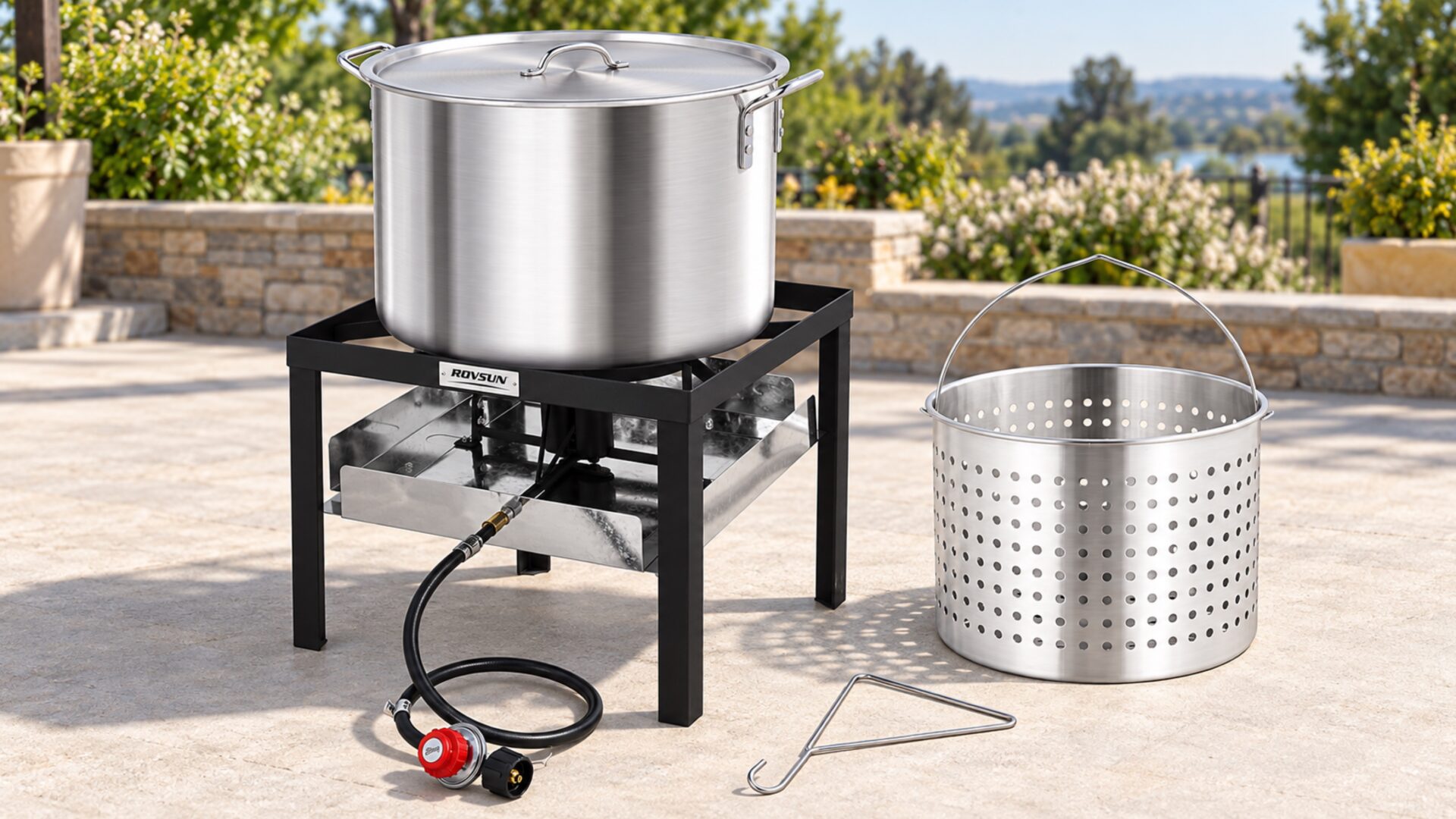
ROVSUN 80QT Review: Built Around Large Batches
The ROVSUN 80QT is a purchase to consider when a conventional turkey pot is too limited for your broader outdoor menu. Its large pot suits cooks planning substantial outdoor batches who have the space to handle, clean, and store oversized cookware. The appeal is capacity for group cooking, particularly meals built around a large boiling vessel. For a household interested mainly in one holiday turkey, that size can create more work than value, and it should never be mistaken for permission to use an arbitrary oil fill or oversized bird.
Pros
- Large vessel suits substantial outdoor batches.
- Pot-and-basket format is useful for appropriate group boiling recipes.
- Burner and cookware are offered together as an outdoor system.
Cons
- Oversized cookware takes substantial cleaning and storage space.
- Nominal capacity does not establish a safe turkey size or oil fill.
- More equipment than most single-turkey households need.
Capacity Is the Reason to Consider This System
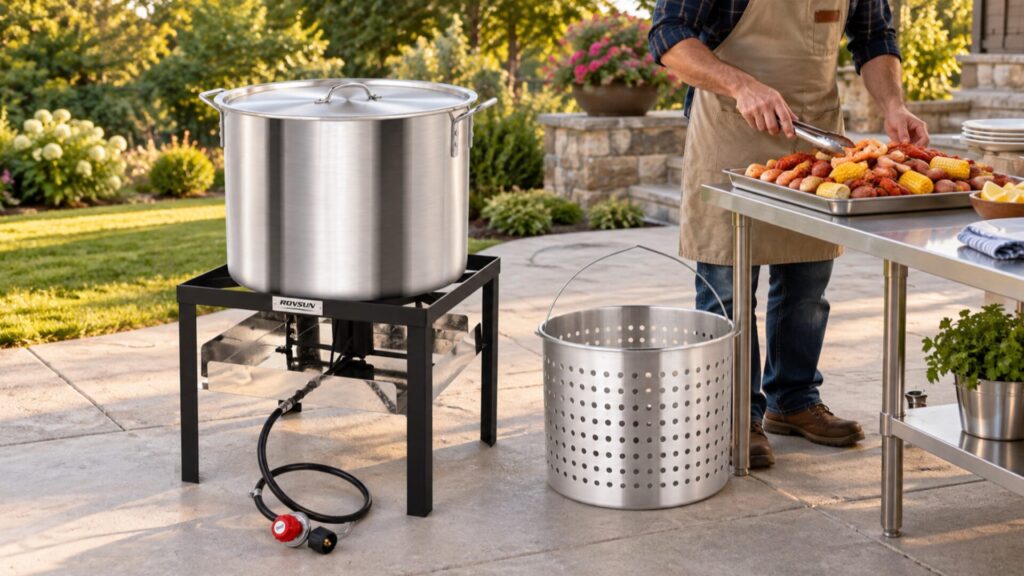
An 80-quart vessel is a substantial step beyond the roughly 30-quart pots in traditional turkey-frying kits. That difference is meaningful for cooks organizing large outdoor batches. It gives this product a distinct role in our lineup rather than making it a direct substitute for every smaller turkey fryer.
Think first about the meal that needs the volume. If your outdoor cooking revolves around group seafood boils or another recipe suited to a large pot and basket, the format has a clear purpose. If the intended meal is a single bird, ask what benefit the extra vessel size will actually provide.
ROVSUN markets this equipment for turkey frying as well as boiling, but the pot’s nominal volume is not a safe operating recipe. It does not establish the appropriate bird size, the permissible oil quantity, or the correct lifting arrangement for a whole turkey. Those details must come from the instructions for the exact supplied equipment.
That is the distinction a buyer should resolve before ordering ingredients. Large capacity can support a larger batch when the recipe and equipment permit it; it does not remove fill limits or handling constraints. Choosing a cooker around a realistic meal is more useful than buying the biggest vessel available and trying to invent a job for it afterward.
High Burner Output Is Only Part of the Equation
The manufacturer specifies a 150,000-BTU propane burner for this system. Such a rating makes sense as part of a product built around a large vessel, but it describes heat input rather than measured cooking speed. The amount of liquid, outdoor conditions, and food load all influence the result.
There is no reason to assume the burner must be operated at maximum output throughout a recipe. Bringing a permitted volume of water toward a boil and controlling oil temperature are different tasks. The right setting depends on the cooking method and the manual’s directions, with appropriate temperature monitoring where required.
The supplied regulator and hose belong to the cooking system. Do not regard an adjustable propane setup as an invitation to substitute higher-pressure parts or chase a larger flame. A buyer considering equipment at this scale should be comfortable reading and following the operating instructions rather than treating burner output as a shortcut around them.
Compared with the CreoleFeast TFS3010, the ROVSUN makes a different bargain. CreoleFeast supplies cookware for larger and smaller meals on one burner; ROVSUN concentrates on a much larger vessel. If your usual batch is modest, a smaller system may be easier to organize even if its specification sheet lists less power.
Large Cookware Changes the Setup and Handling
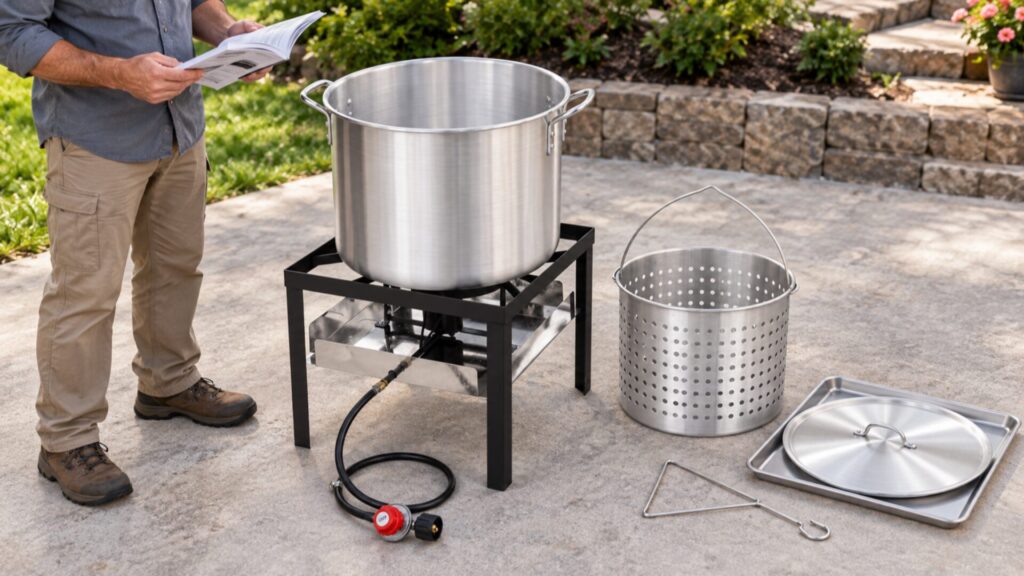
An oversized pot demands an appropriately planned cooking area. Start with a firm, level, noncombustible surface and the clearances required by the manufacturer. The stand cannot turn uneven ground into a safe working area, and an open patch near the party is not enough if guests must walk around the cylinder or hose.
Consider the complete sequence before filling the vessel. You need somewhere to stage uncooked ingredients, somewhere appropriate for the cooked food, and a way to use the supplied handling equipment as directed. Those arrangements become more important as the size and weight of a batch increase.
The basket is useful for foods suited to basket cooking, but it is not a universal lifting solution. Confirm that the rack, basket, and handling method are appropriate for your intended recipe, particularly if you plan to cook a whole bird. Do not improvise a turkey support because the pot has enough room for it.
Check the exact carton contents before committing to a meal. Manufacturer descriptions and package lists should be reconciled with the equipment you receive; do not assume every accessory pictured across related listings is included. In particular, establish that you have the required temperature tools and the correct food support for the cooking method you intend to use.
Our turkey fryer safety tips cover the general preparation, but the supplied manual controls the specific setup and limits. If the instructions do not clearly cover the turkey and arrangement you have in mind, resolve that with the manufacturer before attempting the cook.
Cleanup and Storage Are Significant Buying Factors
Large-pot ownership continues after the guests leave. The vessel and its contents must cool before handling, and the area needs to remain protected during that time. You cannot assume the cooking station will be ready to pack away as soon as the food is served.
Cleaning an 80-quart pot and basket also requires a suitable space. Consider where you will wash them, how you will drain and dry them, and whether the available area allows you to work without awkward lifting. These are practical purchase questions, especially if your kitchen sink is the only cleaning location you have considered.
The aluminum cookware should be cleaned according to the manufacturer’s directions. Avoid assuming that a method used on another material is appropriate here. Store the dry cookware and accessories together, protect the burner equipment as directed, and inspect the gas components before subsequent use.
Cost is broader than the equipment price. Larger recipes require more ingredients, and the quantities of cooking liquid and fuel depend on the permitted setup. For oil frying, buy oil only after establishing the correct fill requirement. There is no useful universal gallon figure to infer from the “80QT” name.
If storage space is limited or your gatherings are occasional, the King Kooker 1265BF3 is a more conventional starting point for frying and boiling. If your priority is avoiding a large oil bath, the Charbroil The Big Easy answers a different need. Neither offers the same large-pot format, but either may match the actual meal better.
Should You Buy the ROVSUN 80QT?
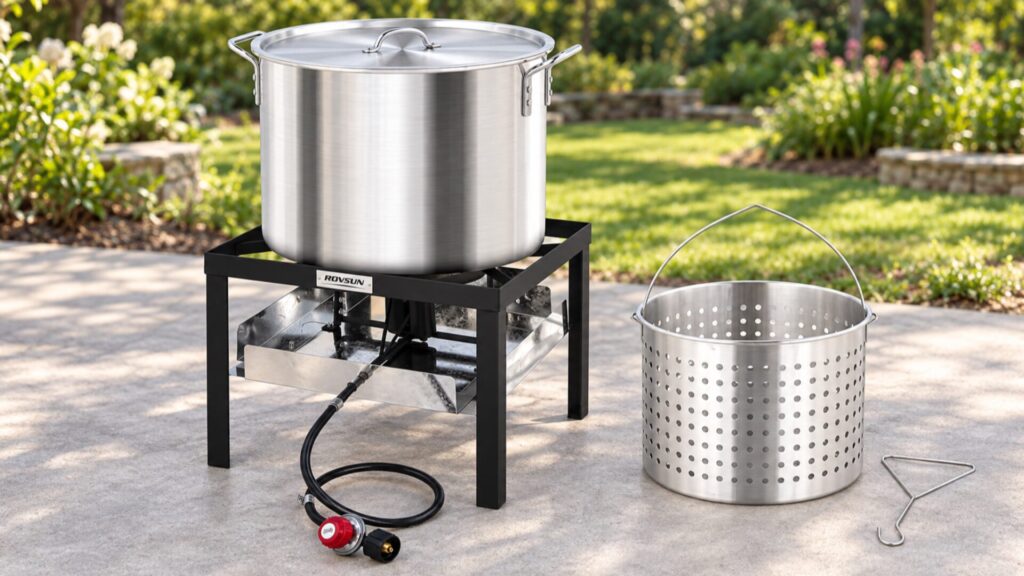
Choose this system when you can name the large-batch meals that justify it and have the outdoor workspace to manage them. Its strongest case is for a cook who has outgrown conventional pot capacity, rather than someone buying a first fryer for a single holiday dinner. The extra size needs to solve a real problem.
For turkey frying specifically, confirm the exact operating instructions, permitted food size, fill procedure, and accessories before purchase. Do not let the product name or a large BTU figure substitute for those details. Our best turkey fryers comparison can help narrow the choice by cooking method and ownership demands.
For most smaller households, one of the conventional sets will be the more practical buy. For organized group cooking where a large vessel is genuinely useful, the ROVSUN 80QT has a clear place, provided its scale fits both your menu and your available space.