
Best Binoculars for Every Budget and Outdoor Use
Today’s best binoculars combine clear optics, durable construction, and comfortable handling for birding, wildlife, sports, and travel. The right pair makes a distant subject easier to find and more rewarding to study, but the most useful binocular is rarely the one with the largest number printed on the body. Magnification, objective size, field of view, eye relief, close focus, weight, and weather protection all affect whether an optic feels natural in the situations where it will actually be used.
Best Binoculars Comparison
| Best Overall | Bang for Your Buck | Best on a Budget | Best for Birdwatching | Best for Kids |
|---|---|---|---|---|
| Nikon MONARCH M7 | Vortex Diamondback HD | Celestron Nature DX | Athlon Optics Midas UHD | Hontry Compact Binoculars |
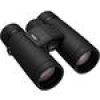 | 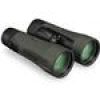 |  |  |  |
| Premium ED-glass optics, a broad 362-foot field of view, weather sealing, and refined controls for demanding outdoor use. | High-magnification 12×50 reach, strong optical coatings, an included GlassPak harness, and Vortex’s exceptional warranty. | A wide, stable 8×42 view with close focusing, eyeglass-friendly eye relief, and dependable weather protection at a modest price. | A spacious 426-foot field of view, ED glass, dielectric-coated prisms, and a magnesium chassis suited to serious birding. | An inexpensive, foldable 10×25 pair that is easy to pack for older children, family trips, concerts, and casual nature viewing. |
This lineup covers five distinct priorities without treating every buyer as though they need the same instrument. The Nikon MONARCH M7 10×42 is the premium all-round choice, the Vortex Diamondback HD 12×50 emphasizes long-range value, the Celestron Nature DX 8×42 delivers affordable outdoor capability, the Athlon Midas UHD 8×42 is built around a bird-friendly wide view, and the Hontry 10×25 offers a compact, low-cost option for older children and family outings.
Every selection remains available through its manufacturer or Amazon listing as of the research date, although inventory and prices can change. Specifications below refer to the exact models named in each section, which matters because most binocular families include multiple magnifications and objective sizes with different fields of view, weights, and handling characteristics.
Choosing the Right Binoculars
How to Read Binocular Numbers
Binoculars are labeled with two numbers separated by an “x.” An 8×42 model magnifies the subject eight times and uses 42mm objective lenses at the front. Higher magnification reveals more distant detail, but it also narrows the field of view and makes hand movement more visible. Larger objectives gather more light, though they increase size and weight.
For general birding and wildlife, 8×42 is the easiest all-purpose format. It provides a broad, steady view and a bright 5.25mm exit pupil. A 10×42 offers more reach with slightly less steadiness and field width. A 12×50 is a specialized long-range choice that benefits from bracing or a tripod. Compact 10×25 binoculars are convenient in bright conditions but cannot match the low-light comfort of a full-size model.
Field of View, Close Focus, and Eye Relief
Field of view describes how wide an area is visible at a stated distance, commonly feet at 1,000 yards. A wide field makes birds, athletes, and moving wildlife easier to locate. The Athlon Midas UHD leads this group at 426 feet, followed by the Celestron Nature DX at 388 feet, Nikon MONARCH M7 at 362 feet, Hontry at a stated 362 feet, and Vortex Diamondback HD at 271 feet. Those figures are not a quality ranking; they reflect different magnifications and design priorities.
Close focus matters for feeder birds, butterflies, plants, exhibits, and nearby details. Six to seven feet is useful for an all-purpose binocular. Eye relief is especially important for eyeglass wearers because insufficient distance can crop the field. Around 16mm to 18mm is often comfortable, while the Hontry’s 10mm specification is more restrictive.
Coatings, Prisms, and ED Glass
Roof-prism binoculars need careful coatings to preserve contrast and resolution. Fully multi-coated optics apply anti-reflective layers to all air-to-glass surfaces. Phase correction improves fine detail in roof-prism systems, and dielectric prism coatings increase reflectivity and support natural color. The Nikon and Athlon add ED glass to reduce chromatic aberration around high-contrast edges.
Coating labels do not tell the entire story, because optical design, manufacturing tolerances, baffling, and quality control also shape the view. They are still useful indicators when comparing models in similar price ranges. A binocular with basic coatings can be enjoyable, while a well-executed ED and dielectric system tends to preserve cleaner detail in difficult light.
Weather Protection and Care
Waterproof sealing and nitrogen or argon purging help keep moisture out and prevent internal fogging when temperatures change. Rubber armor improves grip and protects against routine bumps, but no binocular should be treated as indestructible. Lens caps, a case, and a harness remain important, particularly around sand, dust, rain, and brush.
Cleaning should begin by blowing or brushing away loose grit. Remaining fingerprints and spots can be removed with a clean microfiber cloth and lens-safe solution. Wet binoculars should dry at room temperature before being closed in a case. Never look at the sun through binoculars, and supervise children until that rule is fully understood.
Best Overall: Nikon MONARCH M7
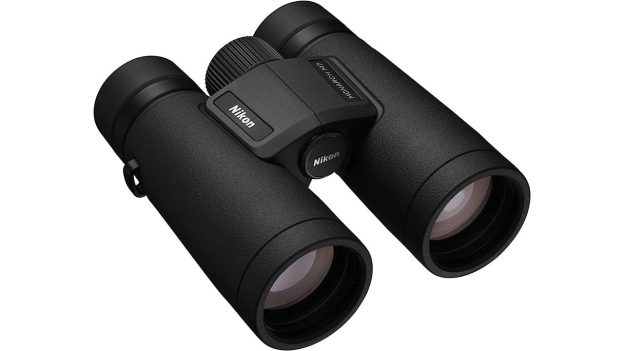
- ED glass and premium prism coatings deliver bright, color-accurate views with controlled fringing.
- Ten-power reach and a 362-foot field of view balance distant detail with easier subject tracking.
- Waterproof, nitrogen-filled, rubber-armored construction is built for dependable year-round field use.
The Nikon MONARCH M7 10×42 is the strongest all-round choice for buyers who want premium optical performance without stepping into flagship pricing. Ten-power magnification adds reach for wildlife, shorelines, mountain views, and outdoor sports, while the unusually broad 362-foot field keeps subject acquisition more responsive than many 10x binoculars.
Nikon uses ED glass, phase-corrected roof prisms, dielectric multilayer prism coatings, and oil- and water-repellent exterior lens coatings. The combination is designed to control color fringing, preserve fine detail, maintain natural color, and simplify cleaning. A locking diopter and turn-and-slide eyecups support repeatable setup, and 16.5mm of eye relief accommodates many eyeglass wearers.
The 24-ounce body is substantial enough to feel stable without becoming a burden on a supportive strap or harness. Waterproofing, nitrogen filling, rubber armor, and a closed-bridge design make it suitable for frequent outdoor use. Users who prefer maximum steadiness or mostly bird in dense woodland may choose the 8×42 version, but the 10×42 model offers the best balance of reach, field width, and premium refinement in this group.
Bang for Your Buck: Vortex Diamondback HD
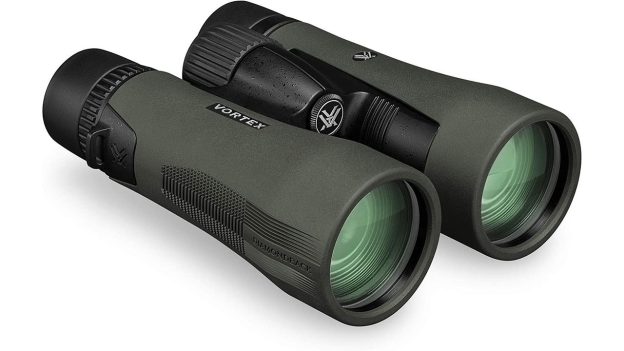
- The 12×50 configuration provides strong long-range reach and useful light gathering for open-country viewing.
- HD glass, phase correction, and dielectric prism coatings support sharp detail and solid contrast.
- An included GlassPak harness, rugged weather sealing, and the VIP warranty add practical value.
The Vortex Diamondback HD 12×50 is the value choice for buyers who need genuine long-range reach. Twelve-power magnification reveals more detail across open fields, valleys, coastlines, and stadiums than an 8x or 10x binocular. The 50mm objectives preserve a useful 4.17mm exit pupil, and the optical system combines fully multi-coated lenses, dielectric prism coatings, and phase correction.
This is a specialized format rather than a universal one. The 271-foot field of view is narrower, 28.9 ounces is noticeable at eye level, and 12x magnifies hand shake. The binocular is tripod adaptable, and stable support is the best way to extract its full resolution during long observation. Vortex includes a GlassPak harness, which manages the weight and protects the optic better than a simple neck strap.
Argon purging, O-ring sealing, ArmorTek exterior lens protection, rubber armor, and Vortex’s VIP warranty make the package unusually reassuring for the price. It is ideal for long-range wildlife and stationary observation, but fast birding in dense habitat is better served by a wide 8×42.
Best on a Budget: Celestron Nature DX
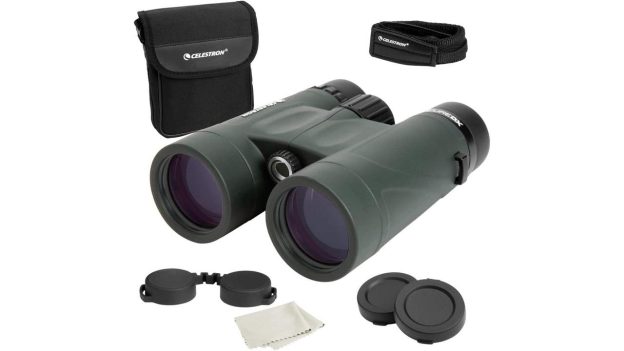
- A steady 8×42 format and broad 388-foot field make wildlife and moving subjects easier to find and follow.
- Fully multi-coated optics and phase-coated BaK-4 prisms outperform many basic entry-level binoculars.
- The lightweight, waterproof, nitrogen-filled body is easy to carry and comfortable for eyeglass wearers.
The Celestron Nature DX 8×42 delivers the specifications that matter most to new birders and general outdoor users. Eight-power magnification is steady, the 388-foot field is broad, and the 6.5-foot close focus covers nearby birds, flowers, insects, and exhibits. The 17.5mm eye relief and multi-stop twist-up eyecups also make it one of the friendliest options for glasses.
Celestron uses fully multi-coated optics and phase-coated BaK-4 prisms, a meaningful step above lightly coated entry-level designs. The binocular does not use ED glass, so premium models can provide cleaner high-contrast edges and better refinement toward the field perimeter. Those differences are reasonable at this price, and the central view remains well suited to learning bird identification and exploring outdoor subjects.
The rubber-armored polycarbonate body is waterproof, fogproof, nitrogen filled, and tripod adaptable. At 22.2 ounces, it is easy to carry for a full-size 8×42. The Nature DX is the most sensible starting point for buyers who want serious binocular fundamentals while keeping the budget under control.
Best for Birdwatching: Athlon Midas UHD
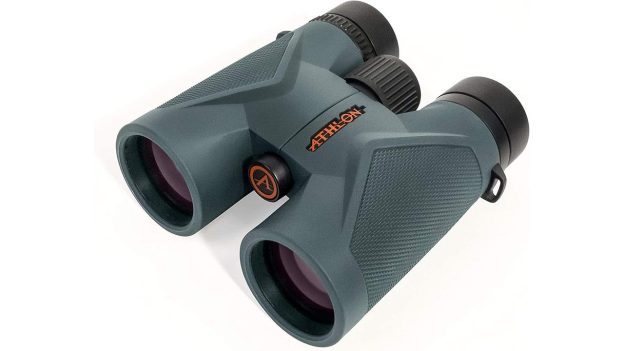
- An exceptionally wide 426-foot field of view makes it easier to locate and track fast-moving birds.
- ED glass with dielectric and phase-corrected prism coatings delivers crisp detail and strong contrast.
- A magnesium chassis, argon purging, and generous eye relief support comfortable, durable field use.
The Athlon Midas UHD 8×42 is the birding specialist because its 426-foot field of view makes moving subjects unusually easy to locate and follow. Eight-power magnification remains steady during long handheld sessions, and the 42mm objectives create a bright 5.25mm exit pupil for wooded trails, overcast weather, and the edges of the day.
Optical features include extra-low-dispersion glass, advanced fully multi-coated lenses, phase-corrected BaK-4 prisms, and Athlon’s ESP dielectric prism coating. These technologies target color fringing, transmission, contrast, and accurate color—the qualities that help separate plumage markings and subtle tones in difficult light. A 6.5-foot close focus and 17.2mm eye relief broaden its usefulness for feeder viewing and eyeglass wearers.
The magnesium chassis, rubber armor, XPL exterior lens coating, waterproof construction, and argon purging create a durable field package. Model 113004 is a limited-distribution product, so buyers should confirm the exact model number and current seller. For birders who value a spacious, responsive view more than maximum magnification, the Midas UHD is the most purpose-fit choice here.
Best for Kids: Hontry Compact Binoculars
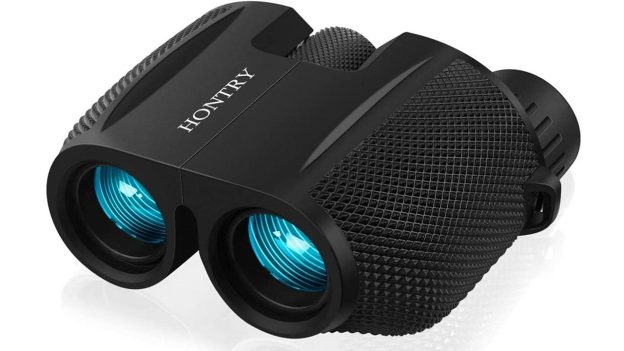
- The compact folding body is inexpensive, lightweight, and easy to keep in a family day bag.
- Ten-power magnification provides useful reach for nature walks, sports, concerts, and travel in bright conditions.
- Simple focusing and textured grips make the binoculars approachable for supervised older children and beginners.
The Hontry 10×25 is the most approachable choice for older children and family use because it is inexpensive, foldable, and easy to keep in a day bag. Ten-power magnification provides useful reach at parks, sports, concerts, and scenic viewpoints, while the manufacturer states a broad 362-foot field of view at 1,000 yards.
Compactness creates predictable compromises. The 25mm objectives produce a small 2.5mm exit pupil, so the binocular works best in bright light. Ten-power magnification can be shaky in small hands, and the listed 10mm eye relief is not ideal for glasses. The model also lacks a clear published waterproof or nitrogen-purged rating, so it should be treated as a fair-weather optic rather than a rugged field tool.
The Hontry is most appropriate for school-age children and teens who can focus carefully, use the strap, keep fingers off the lenses, and understand that binoculars must never be aimed at the sun. Adult supervision is essential until those habits are reliable. Within those limits, model 8111 offers a low-cost way to encourage observation without risking expensive equipment.
Conclusion
The best binocular is the one whose compromises match the job. The Nikon MONARCH M7 10×42 provides the most complete premium balance, with meaningful reach, a broad field, ED glass, weather sealing, and refined adjustments. The Vortex Diamondback HD 12×50 is the stronger long-range value when stable support is available. The Celestron Nature DX 8×42 offers the most convincing budget entry into serious outdoor optics.
Birders receive the most responsive view from the Athlon Midas UHD 8×42, whose 426-foot field and close focus make it easy to move between nearby habitat and fast subjects. Families seeking a compact, inexpensive shared optic can choose the Hontry 10×25 for older children, provided expectations remain grounded in its small objectives, 10x shake, short eye relief, and fair-weather construction.
Choose magnification only after deciding where the binocular will be used, how long it will be carried, whether glasses are involved, and how much stability the user can provide. A well-matched 8×42 will reveal more in practice than a powerful binocular that is too shaky, narrow, heavy, or uncomfortable to use.
How do I choose the right magnification for my binoculars?
Choosing the right magnification depends on your intended use and personal preferences. For general-purpose birdwatching or wildlife observation, 8x or 10x magnification is common because it strikes a balance between magnifying distant subjects and maintaining image stability. Higher magnifications like 12x or 15x are better suited for observing distant objects but may be more challenging to stabilize without a tripod, particularly in windy conditions.
Are waterproof binoculars worth the extra cost?
Waterproof binoculars are worth the extra cost if you plan to use them in wet or humid conditions, such as rainforests, marshlands, or marine environments. They provide added protection against moisture and fogging, ensuring long-term durability and clear viewing even in challenging weather conditions. Models like the Vortex Optics Diamondback HD or Nikon Monarch M7 feature waterproof and fog-proof construction, making them suitable for outdoor enthusiasts who require reliable performance in any environment.
What is the difference between roof prism and Porro prism binoculars?
The main difference between roof prism and Porro prism binoculars lies in their internal prism design. Roof prism binoculars have a more compact and streamlined design, with the prisms aligned in a straight line within the optical tube. Porro prism binoculars have an offset prism design, which results in a wider inter-pupil distance and often better depth perception and image quality. While roof prism binoculars are more compact and easier to hold, Porro prism binoculars may offer better optical performance in terms of image clarity and brightness.
Can I use binoculars for stargazing?
Yes, you can use binoculars for stargazing, especially models with larger objective lenses and lower magnification. Binoculars provide a wider field of view than telescopes, making them ideal for observing constellations, star clusters, and even some planets. Models like the Celestron Nature DX or Athlon Optics Midas Binoculars with 42mm or 50mm objective lenses and lower magnification (e.g., 8x or 10x) are well-suited for stargazing, as they gather more light and provide a broader view of the night sky.
What is the importance of lens coating in binoculars?
Lens coating reduces glare, increases light transmission, and enhances image contrast and clarity. High-quality coatings like fully multi-coated or phase-coated lenses minimize light reflection and produce sharper, brighter images, particularly in challenging lighting conditions.
How do I properly clean and maintain my binoculars?
Properly cleaning and maintaining your binoculars is essential for ensuring optimal performance and longevity. Begin by removing any loose debris or dust particles from the lenses and exterior surfaces using a soft brush or air blower. Next, gently wipe the lenses and prism surfaces with a microfiber cloth or lens cleaning tissue moistened with a lens cleaning solution. Avoid using harsh chemicals or abrasive materials that could damage the lens coatings. If stubborn dirt or smudges persist, use a lens cleaning solution specifically designed for optical surfaces. Be sure to clean the eyepieces and focus wheel as well. To maintain the mechanical components, periodically lubricate the hinge and focus mechanisms with a small amount of lubricant suitable for precision instruments. Store your binoculars in a dry, protective case when not in use, and avoid exposing them to extreme temperatures or humidity. With regular cleaning and proper care, your binoculars will continue to provide clear, sharp views for years to come.
Can I use binoculars while wearing glasses?
Yes, many binoculars feature adjustable eyecups or eye relief to accommodate users who wear glasses. Twist-up eyecups or long eye relief allow for comfortable viewing with or without glasses.