
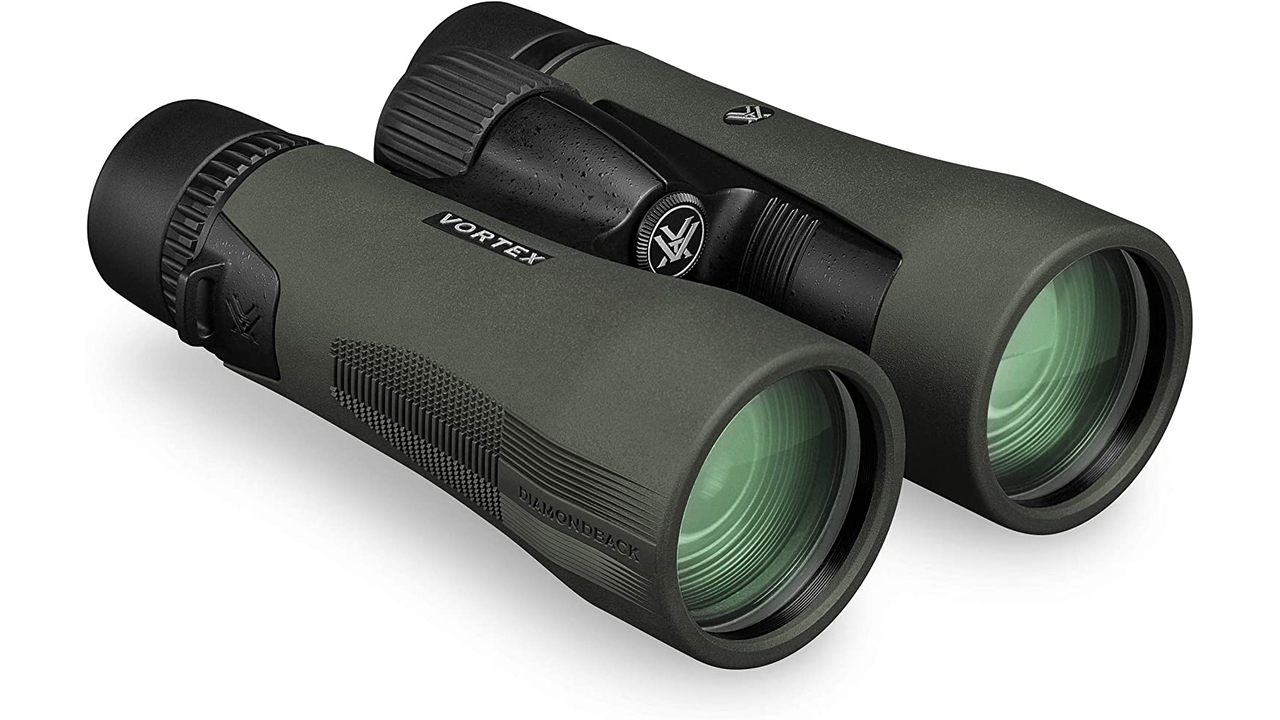
Vortex Optics Diamondback HD Binoculars 12×50
The Vortex Diamondback HD 12×50 delivers powerful long-range reach, durable weather protection, and an excellent warranty at a practical price. Model DB-217 is built for observers who regularly watch distant wildlife, scan open country, study targets from fixed viewpoints, or want more detail at outdoor sporting events than an 8x or 10x binocular can provide.
The 12x magnification is both the attraction and the main compromise. It enlarges fine detail, but it also magnifies hand movement and narrows the view. Vortex lists a 271-foot field of view at 1,000 yards, 14mm of eye relief, a close-focus distance of six feet, and a weight of 28.9 ounces. Those numbers describe a binocular that can be handheld for brief sessions but rewards bracing, a monopod, or a tripod during longer observation.
The Diamondback HD line supports that high-power format with fully multi-coated lenses, dielectric prism coatings, phase correction, ArmorTek exterior lens protection, argon purging, O-ring sealing, and a shock-resistant rubber-armored body. The included GlassPak harness is not a token accessory; it helps manage the weight and keeps the binocular ready without hanging from the neck.
Pros
- 12x magnification reveals more distant detail than common 8x and 10x binoculars.
- HD optical system, dielectric coatings, and phase correction support sharp, color-accurate views.
- Six-foot close focus adds surprising versatility for a 12×50 design.
- GlassPak harness, lens covers, rainguard, strap, and cloth are included.
- Vortex VIP warranty provides unusually broad long-term support.
Cons
- Hand shake is more visible at 12x, especially during prolonged viewing.
- 28.9-ounce weight and 50mm objectives add bulk to a day pack.
- Fourteen millimeters of eye relief may be restrictive for some eyeglass wearers.
- 271-foot field of view is less responsive for close, fast-moving birds.
Why 12×50 Changes the Viewing Experience
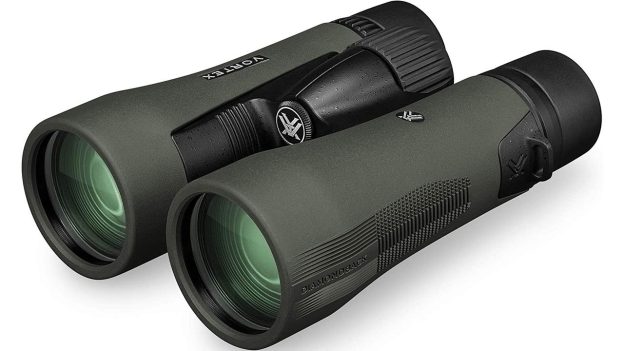
Moving from 8x or 10x to 12x is more significant than the numbers initially suggest. A distant animal, trail marker, sail number, or architectural detail occupies more of the view, making identification easier when the subject remains far away. The 50mm objective lenses gather more light than compact high-power binoculars, producing a 4.17mm exit pupil that remains useful in overcast weather and around dawn or dusk.
The cost of that reach is stability. Every pulse, breath, and shift of the hands is enlarged along with the subject. Short observations can be comfortable when elbows are braced against the body, a railing, a vehicle roof, or a tree. For patient glassing across valleys or fields, the tripod-adaptable design is the better solution. A simple L-adapter and stable support can turn the Diamondback HD from a somewhat restless handheld optic into a much more precise long-range tool.
The 271-foot field of view also requires deliberate subject acquisition. It is adequate for scanning open terrain, but less suited to finding a small bird that suddenly appears in nearby foliage. Users who prioritize quick tracking over distant detail will be happier at 8x. The 12×50 is designed for reach first, with enough optical quality and ergonomics to make that reach practical.
Optical System and Low-Light Tradeoffs

Vortex describes the Diamondback HD optical system as using selected glass elements to improve resolution, color fidelity, and edge-to-edge sharpness while reducing chromatic aberration. Fully multi-coated air-to-glass surfaces improve transmission, and dielectric prism coatings return more light through the roof-prism system. Phase correction supports contrast and fine resolution, which matters because high magnification exposes optical softness that can be less obvious at lower power.
The 50mm objectives help maintain brightness, but 12x still produces a smaller exit pupil than an 8×42. The view can remain useful in fading light, yet a large 8x or 10x binocular generally feels more relaxed when the pupil is dilated and the subject is moving. The Diamondback’s advantage is detail at distance rather than maximum twilight brightness. Hunters and wildlife watchers should match that distinction to the terrain: open areas reward magnification, while dense woods reward field of view and steadiness.
Vortex lists a close-focus distance of six feet, an unusually flexible specification for a 12×50. At close range, the high magnification can reveal feather texture, bark, insects, or display details, although the narrow depth of field demands precise focusing. The large center wheel is positioned for quick adjustment, and the right-side diopter compensates for differences between the user’s eyes.
Harness, Tripod Use, and Field Handling
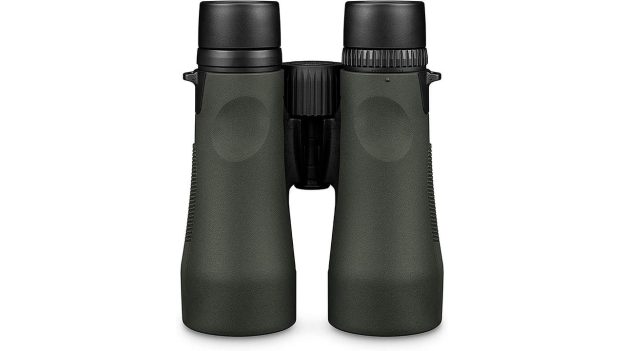
At 6.4 inches high, 5.3 inches wide, and 28.9 ounces, the Diamondback HD 12×50 is not discreet pocket glass. The included GlassPak harness therefore adds real value. It distributes the load across the shoulders, limits bouncing, and places a protective pouch between the binocular and brush, dust, or a vehicle interior. The standard neck strap remains useful for short sessions, but the harness is the sensible default for hikes and long days outside.
The open-hinge body gives the hands more room to wrap around the barrels and reduces material through the center. Rubber armor adds grip in wet or cold conditions. Twist-up eyecups accommodate users with and without glasses, though the 14mm eye-relief specification is modest. Some eyeglass wearers may not see the entire field, particularly with thick frames or lenses positioned farther from the eye. Trying the binocular before committing is worthwhile when full-field comfort is a priority.
Tripod compatibility should be treated as a core capability rather than an optional extra. Removing the front hinge cap exposes the adapter socket. A compact monopod improves steadiness while remaining mobile; a tripod is better for extended glassing, astronomy, or shared observation. Stable support also reduces fatigue because the user is no longer gripping nearly two pounds of optics at eye level.
Durability, Warranty, and Best-Fit Uses

The body is argon purged and O-ring sealed for waterproof and fogproof performance. ArmorTek protects exposed lens surfaces from scratches, oil, and dirt, while the rubber armor provides a non-slip exterior and ordinary impact protection. These measures improve resilience, but caps and a case still matter. Sand and grit should be blown away before wiping, and wet optics should dry outside the closed harness pouch.
Vortex’s VIP warranty is one of the strongest reasons to consider the brand. The company states that damaged or defective Vortex products will be repaired or replaced without charge, subject to exclusions such as loss, theft, deliberate damage, or purely cosmetic damage that does not affect performance. Warranty terms can change, so purchase records and the current policy should be checked, but the program is notably less restrictive than many conventional limited warranties.
The 12×50 Diamondback HD is best for open-country wildlife viewing, hunting observation, coastal watching, scenic overlooks, astronomy, and sporting events where distance is the central problem. It is less suitable as a first binocular for a child, a compact travel companion, or a fast birding optic in dense habitat. Buyers who accept the need for steadier technique receive considerable reach, a complete accessory package, and durable support without moving into premium-glass pricing.
Conclusion
The Vortex Diamondback HD 12×50 is a purpose-driven value choice. Its 12x magnification and 50mm objectives bring distant subjects closer, while dielectric coatings, phase correction, fully multi-coated lenses, and weather sealing help preserve a clear and dependable view. The six-foot close focus and included GlassPak harness broaden its usefulness beyond static long-range observation.
The main question is not whether the binocular has enough power, but whether the user can support it well. Those willing to brace, use a monopod, or mount it on a tripod will extract far more detail than casual handheld use allows. For open terrain and long-range viewing, the Diamondback HD offers strong performance and exceptional warranty backing at a sensible cost.