
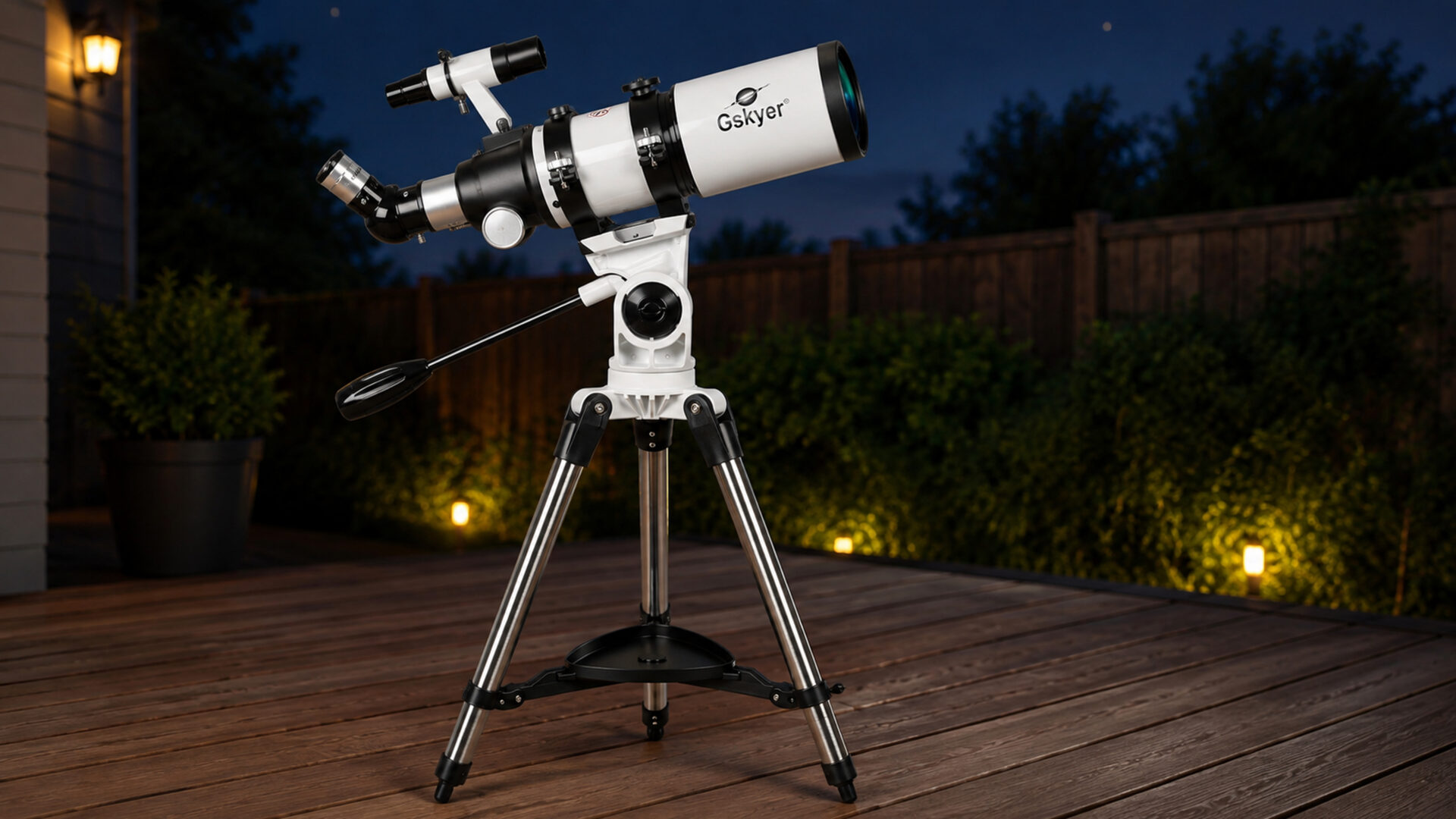
Gskyer 80mm AZ Review: Budget Stargazing in a Box
The Gskyer 80mm AZ Refractor Telescope puts a short 80mm tube, three eyepieces, a Barlow lens and phone accessories into one affordable package. It makes sense for families and curious beginners who want broad lunar and star-field views without assembling a system, as long as its 240x eyepiece-and-Barlow pairing, basic diagonal and uneven instructions are treated with healthy skepticism.
Pros
- The package includes the core accessories needed for a first observing session.
- An 80mm aperture and 400mm focal length create bright, broad low-power views.
- The stainless-steel tripod is more substantial than many ultra-budget tabletop supports.
- A smartphone adapter and remote can capture simple lunar and daytime images.
Cons
- The 240x eyepiece-and-Barlow combination is not realistic for routine viewing.
- The 48-degree erecting diagonal can become awkward high in the night sky.
- The eyepieces and focuser are entry-level and documentation may require supplementation.
- The short achromatic optics show color fringing on bright targets.
A Complete Kit at a Low Entry Price
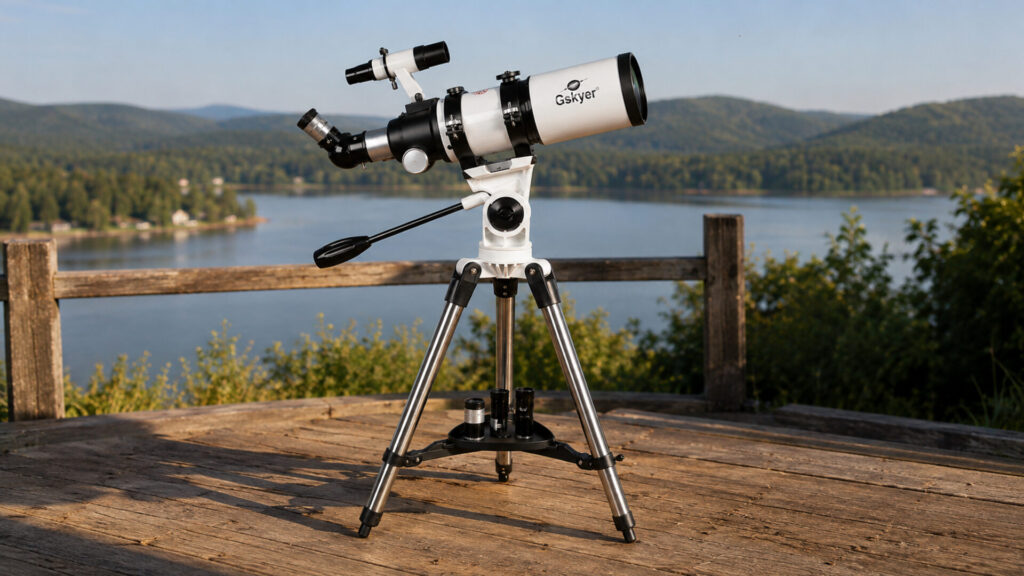
The AZ80400 bundle includes an 80mm refractor, manual alt-azimuth mount, adjustable stainless-steel tripod, 6×30 finder, 25mm, 10mm and 5mm eyepieces, 3x Barlow lens, 48-degree erecting diagonal, smartphone adapter and Bluetooth remote. That breadth reduces the chance that a first-time buyer opens the box and discovers a missing eyepiece or support. It also makes the product easy to give as one self-contained package.
A well-stocked bundle does not mean every component is equally strong. The eyepieces provide useful starting magnifications, but they have basic housings and may be less comfortable than better glass. The phone adapter is suitable for bright targets, while the remote helps avoid touching the telescope during a capture. Neither turns the setup into a tracked deep-sky camera system.
The tripod is a welcome step above very light toy-like supports, yet the system still depends on careful tightening and a balanced tube. Test every lock during the return period, confirm that the focuser holds position and align the finder before dark. Online guides or a beginner astronomy book may explain setup more clearly than the bundled material, depending on the package revision.
What an 80mm f/5 Refractor Can Show
The telescope uses an 80mm aperture and 400mm focal length, making it an f/5 achromatic refractor. The 25mm eyepiece produces 16x, the 10mm gives 40x and the 5mm gives 80x. Those three views cover broad sky scanning, larger clusters, the Moon and basic looks at Jupiter and Saturn. Dark skies improve nebulae and brighter galaxies, though an 80mm lens cannot transform faint objects into colorful photographs.
Short focal length is especially friendly to large targets and navigation. The Pleiades, Hyades and broad Milky Way regions fit more comfortably than they do in a long f/10 telescope. The Moon is bright and rewarding, and Jupiter’s four large moons are accessible. Saturn’s rings can separate from the planet at useful power. Small planetary features and dim galaxies remain modest because aperture and optical correction set real limits.
As an achromat, the objective can show colored halos around the Moon, Venus and other bright subjects. The effect grows at higher magnification. Focus carefully and judge the clearest detail rather than trying to erase the design characteristic. A larger 102mm refractor such as the Celestron AstroMaster 102AZ gathers more light, while an ED refractor improves color correction at a higher price.
Treat the Barlow and Phone Mount Realistically
Combining the 5mm eyepiece with the supplied 3x Barlow creates 240x on paper. The calculation is correct, but the image usually is not useful. A common rough ceiling is about twice the aperture in millimeters, or 160x for this telescope, and atmospheric steadiness, optical quality and mount vibration often pull the practical limit closer to 100x or 130x. Empty magnification enlarges blur without revealing new detail.
The Barlow can still be useful with longer eyepieces. Pairing it with the 25mm eyepiece yields 48x, while the 10mm produces 120x. The 120x combination may work on the Moon or a bright planet when air and alignment are cooperative. Compare it with the clean 80x view instead of assuming the larger number wins. A stable, sharp image usually reveals more than a dim enlarged one.
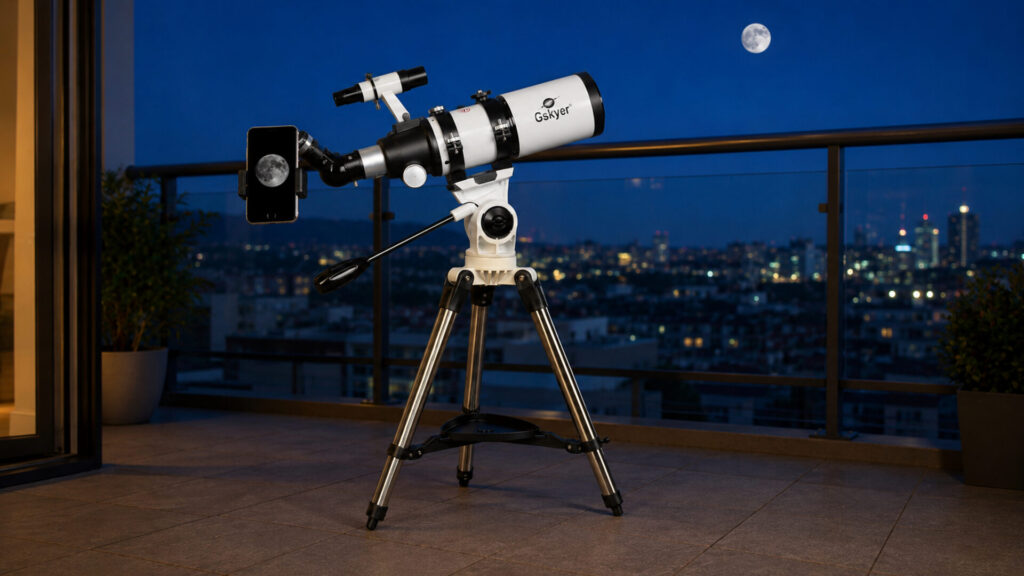
Phone cameras can record the Moon, a distant landscape or a bright planet as a small disk. Centering the lens over the eyepiece is the main challenge, and exposure compensation prevents the Moon from becoming a white featureless circle. Deep-sky phone images shown online often rely on tracking, stacking or computational modes beyond this mount. The adapter is a creative accessory, not evidence that the kit performs like a dedicated astrophotography rig.
Setup Is Simple, Ergonomics Need Patience
The manual mount moves in altitude and azimuth, so a beginner can point it without learning celestial coordinate systems. The erecting diagonal keeps daytime subjects upright, but its 48-degree viewing angle can require an uncomfortable crouch when the telescope points high. Adjusting tripod height or observing from a chair helps. A standard 90-degree star diagonal may become a worthwhile night-sky upgrade if compatibility is confirmed.
A short tube changes balance as heavy accessories are added. Tighten the mount enough to hold position without making movement jerky, and support the optical tube when changing eyepieces. If the focuser slips, consult the model-specific instructions before tightening screws at random. Small mechanical adjustments can improve a budget telescope, but forcing unfamiliar hardware can damage threads or alignment.
Assembly does not require tools, but sparse documentation and uneven accessory refinement can still make the first setup harder than expected. The number of pieces is manageable, yet a new observer may not know what aligned or properly tensioned should feel like. Daylight practice on a distant object, away from the Sun, removes several mysteries before the first clear night.
Should You Buy the Gskyer 80mm AZ Refractor Telescope?
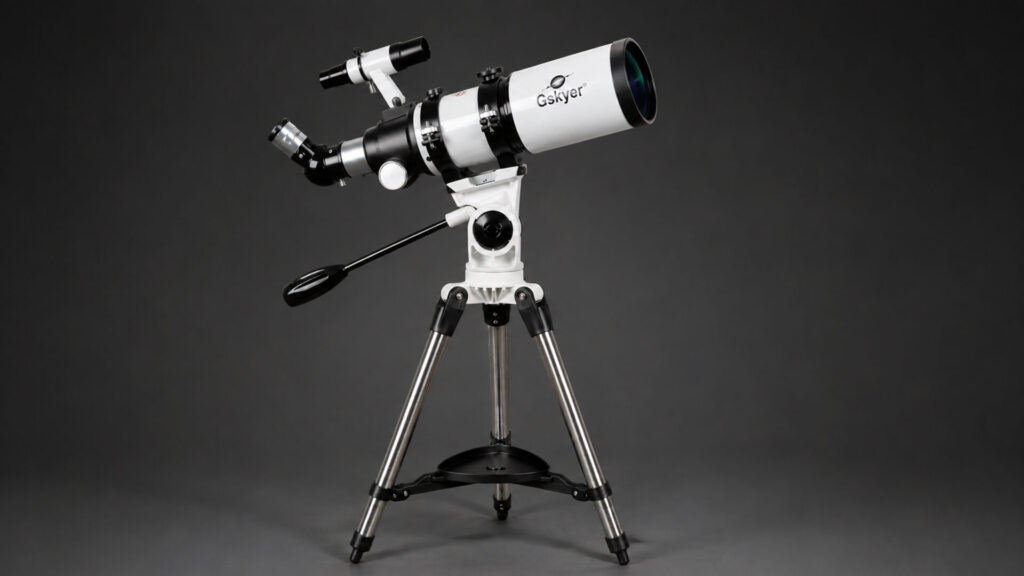
Buy the Gskyer if a complete low-cost kit is more useful than a stronger telescope that immediately needs extra accessories. It offers legitimate lunar, cluster and broad-field observing and gives a curious household several ways to experiment.
Pass if the goal is crisp high-power planets, guided navigation or serious astrophotography. The 240x combination should not drive the decision, and basic accessory ergonomics may require patience or selective upgrades. A smaller set of better components can be more satisfying for a committed observer.
For beginners who accept those limits and want the shortest route from box to first view, the Gskyer 80mm AZ Refractor Telescope is the best budget starter kit in the group.