
AstroMaster 102AZ Review: A Wide-Field Generalist
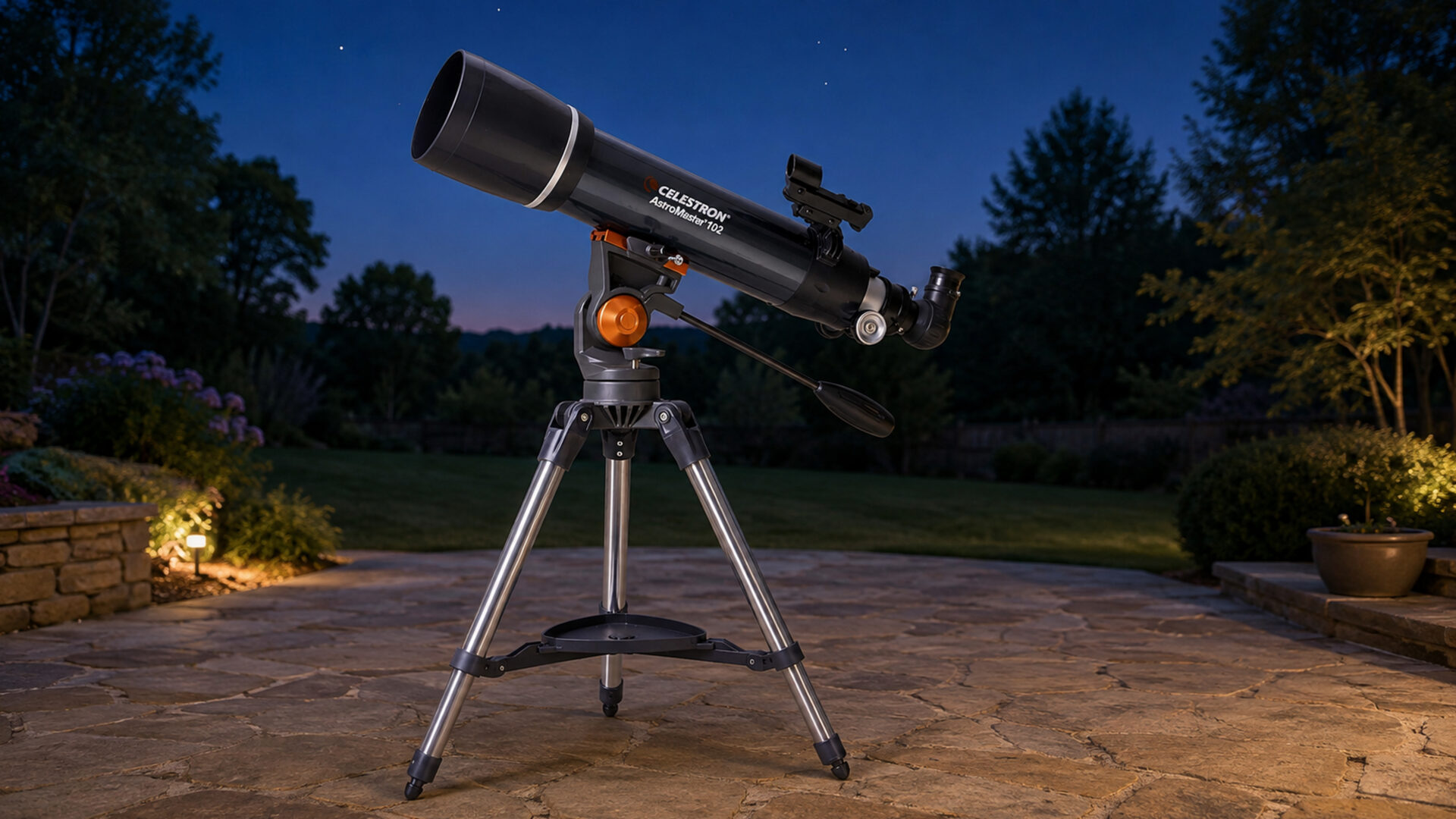
The Celestron AstroMaster 102AZ Telescope is a short 102mm refractor built for broad sky sweeps, quick lunar sessions and upright daytime views. It suits beginners who value tool-free setup and a manageable 12.9-pound system, but its achromatic color fringing and lightweight manual mount make low-to-medium power a more convincing use than ambitious planetary magnification.
Pros
- The 102mm aperture and 660mm focal length provide bright, broad views.
- Tool-free assembly and 12.9-pound total weight support quick sessions.
- The erect-image diagonal makes terrestrial viewing intuitive.
- The 20mm and 10mm eyepieces provide sensible 33x and 66x starting magnifications.
Cons
- The achromatic objective shows purple and blue fringing around bright targets.
- The manual alt-azimuth mount can shake during focusing and at higher power.
- The short focal length is less specialized for detailed planetary work.
- The supplied red-dot finder and eyepieces leave room for later improvement.
A Short Refractor for Broad Views
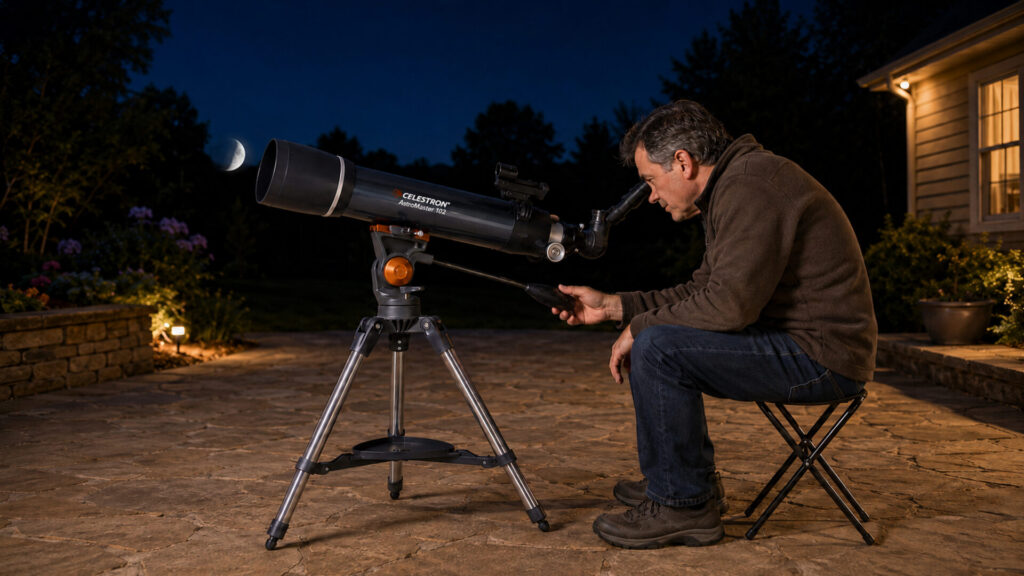
The AstroMaster combines a 102mm objective with a 660mm focal length, making it an f/6.5 achromatic refractor. That specification creates a naturally broad field with the included 20mm eyepiece at 33x. Open clusters, star-rich Milky Way regions, the Moon and larger bright nebulae fit its personality. The 10mm eyepiece raises magnification to 66x for a closer lunar look and the easiest planetary detail.
One specification needs correcting before you calculate magnification: 380mm is the optical-tube length, not the focal length. The telescope’s focal length is 660mm, so a 10mm eyepiece produces 66x rather than 38x. Keep that corrected number in mind when choosing future eyepieces.
A 102mm unobstructed lens can produce crisp contrast at moderate power and gathers noticeably more light than common 70mm beginner refractors. It still cannot compete with an 8-inch reflector on dim galaxies or fine planetary resolution. Its advantage is immediacy: no mirror collimation, a sealed tube and a field broad enough to make finding larger targets less intimidating.
Simple Setup, Imperfect Manual Mount
The optical tube attaches to a manual alt-azimuth mount, which moves in the same up-down and left-right directions used to follow an object visually. No polar alignment, batteries or star database are involved. Assembly requires no tools, and the aluminum tripod adjusts from about 32 to 51 inches. The entire kit weighs 12.9 pounds, light enough for many users to carry outside as one unit.
Low mass is convenient until the telescope is touched. Focusing and high-magnification aiming can introduce vibration, and an extended tripod usually shakes more than a compact one. Keep the legs as short as comfortable, tighten every connection without forcing plastic parts and use the slow-motion control gently. Hanging extra weight is not a universal cure because it can load the mechanism without addressing loose joints.
The red-dot finder helps place a bright target in the main field once aligned. Perform that alignment in daylight on a distant object, never near the Sun, then refine it on a star. The wide optical field forgives small finder errors better than a long focal-length telescope. For casual sessions, the ability to point immediately may be more valuable than computerized navigation.
Color Fringing Sets the High-Power Limit
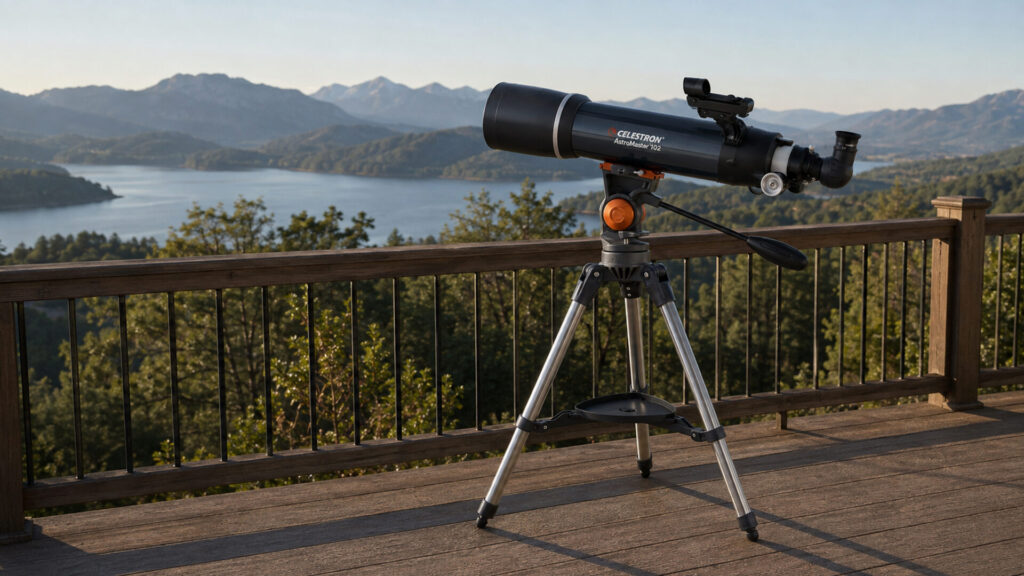
An achromatic doublet brings some colors to a common focus but cannot eliminate chromatic aberration. Bright objects can show violet or blue halos, especially as magnification rises. The Moon remains enjoyable, and Saturn’s rings or Jupiter’s major bands are within reach, but the image will not have the color purity of an ED or apochromatic refractor. This is a design tradeoff, not a focus mistake.
Theoretical maximum magnification is a poor shopping target for this telescope. The mount, atmosphere and short achromatic optics impose more practical limits, while the supplied 33x and 66x views are realistic. Magnification near 100x to 130x can be worthwhile on steady nights with a good eyepiece, but pushing far higher tends to enlarge blur, color and vibration together. Clear detail is the measure, not the number printed beside an accessory.
A minus-violet filter can reduce visible color at the expense of altering the image tone. It is optional, not a requirement to enjoy the telescope. Buyers who know that sharp high-power planets are the central goal should start with a different optical design rather than building a filter strategy around an f/6.5 achromat. The Celestron NexStar 8SE offers substantially more planetary reach at a higher price and setup burden.
One Telescope for Sky and Daytime Use
The included 90-degree erect-image diagonal presents terrestrial scenes with a natural orientation, which makes the telescope useful for distant landscapes and stationary wildlife. At night, the same diagonal keeps the eyepiece in a more comfortable position than a straight-through arrangement. The viewing angle is not ideal at every altitude, but it supports both roles without swapping optical paths.
Daytime use magnifies atmospheric shimmer as well as the subject. Early morning often provides steadier air than a warm afternoon viewed across roofs or pavement. The telescope is not waterproof, and the tripod should remain on secure ground. Most importantly, never aim at or near the Sun without a securely mounted, correctly specified front-aperture solar filter. An eyepiece filter is not a safe substitute.
The dual-purpose design makes storage easier to justify, but it also clarifies the intended performance level. This is a portable generalist for broad fields and moderate magnification. It is not motorized, weather sealed or corrected for demanding photography. A phone can record a simple Moon image through an adapter, though the mount and color correction set practical limits on more elaborate results.
Should You Buy the Celestron AstroMaster 102AZ Telescope?
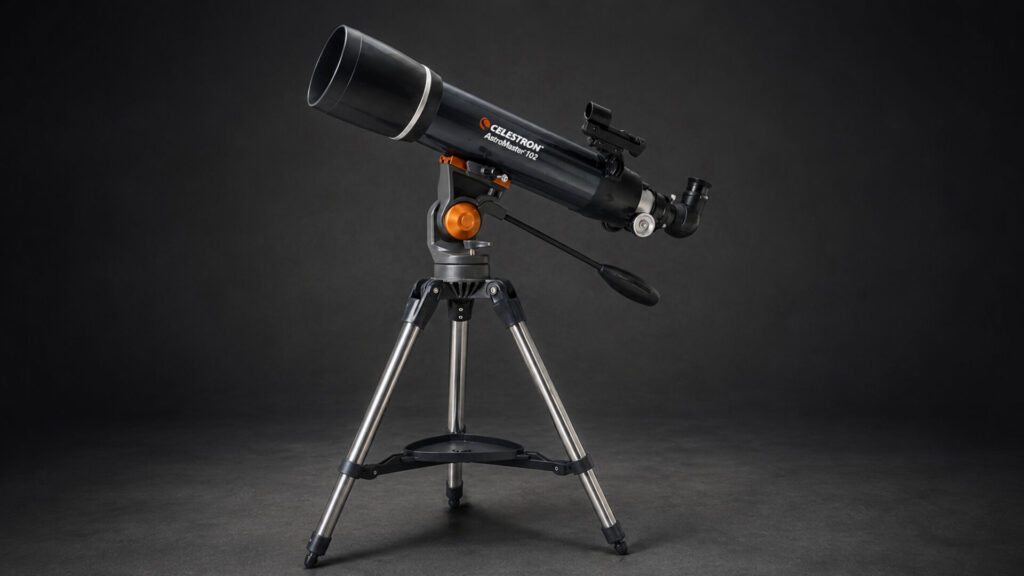
Buy the AstroMaster 102AZ when you prioritize easy setup, wide celestial fields and occasional terrestrial viewing over perfect color correction. Its 102mm aperture is generous for a lightweight refractor, and the 660mm focal length makes the sky approachable at sensible power.
Pass if high-power planets, long-exposure photography or a rock-solid mount are the priority. Chromatic aberration and tripod vibration become increasingly visible as magnification rises. A Dobsonian gives more visual reach for the money if its physical size is acceptable.
As a quick, broad-view instrument used inside its limits, the Celestron AstroMaster 102AZ Telescope is the most versatile wide-field refractor in this lineup.