
Space Heater Savings Depend on What You Stop Heating
Space heater savings are possible when the central-heating cost you avoid exceeds the electricity you add. Warming one occupied office while reducing heating demand elsewhere can make sense. Leaving the central thermostat unchanged and switching on another heater usually adds an expense. The useful question is how much central heat you can safely avoid, not whether the portable heater carries an energy-saving label.
Calculate the Cost of the Heater First
Electricity is billed in kilowatt-hours, or kWh. Divide the heater’s watts by 1,000, multiply by its actual heating time, then multiply by your electricity rate. A 1,500-watt heater uses 1.5 kWh during one hour of continuous full-power heating. The formula is straightforward enough to use without buying another device.
Operating cost = watts ÷ 1,000 × hours of heating × price per kWh.
At an illustrative rate of $0.20 per kWh, a 1,500-watt heater costs $0.30 per hour at full output. Four hours of continuous heating costs $1.20. Repeating that schedule for 30 days costs $36. These examples exclude the purchase price and assume the heating element stays on for the full period.
| Heat setting | 1 hour | 4 hours per day | 30 days |
| 1,500 watts | $0.30 | $1.20 | $36.00 |
| 900 watts | $0.18 | $0.72 | $21.60 |
Illustrative rate: $0.20 per kWh. Assumes continuous heating at the stated wattage, with no thermostat cycling.
Use the rate that applies to additional electricity on your bill. That may include variable delivery charges and taxes as well as the energy-supply charge. Fixed monthly customer charges usually remain whether you use the heater or not. With time-of-use pricing, calculate the hours at the rates when you expect to operate it; an evening peak period can change the answer substantially.
Thermostat Cycling Changes the Total
A heater switched on for four hours does not necessarily heat continuously for four hours. Once the area reaches the thermostat target, the element may cycle off and on. Some models also vary output. The dial setting, room temperature, drafts, and outdoor weather affect how much heating is actually required.
Suppose a 1,500-watt heater heats at full power for half of a four-hour session. That is approximately two equivalent full-power hours, or 3 kWh, costing $0.60 at the example rate. Over 30 days, the heating portion would cost about $18 instead of $36. Fan and control consumption can add a small amount, depending on the design. A 50 percent duty cycle is an example, not a prediction for your room.
Low heat reduces the power used while the element is active, but also reduces output. A 900-watt setting at $0.20 per kWh costs $0.18 per continuous hour. If it has to run longer to provide the same amount of warmth, the difference in total cost may shrink. The thermostat manages comfort; it does not remove the room’s underlying heat loss.
Compare Added Electricity With Avoided Central Heat
The net calculation is the central-heating expense avoided minus the portable heater’s added operating cost. If a change in heating habits avoids $25 of central-heating expense but adds $36 of electricity, the household spends $11 more. If it avoids $50 and adds $18, the operating saving is $32. Both examples are hypothetical, but they show why the portable heater’s own cost is only half the calculation.
A single occupied room offers more potential than several rooms heated by separate portable units. Three 1,500-watt heaters running continuously use 4.5 kWh each hour, costing $0.90 at the example rate. That quickly erodes the appeal of inexpensive individual appliances. It also increases the demands on household electrical circuits, which may serve several outlets rather than one room each.
An efficient central system can still be economical despite serving a larger area. Compare actual fuel costs and equipment performance rather than assuming smaller always means cheaper. Weather changes complicate comparisons between utility bills, so one warmer month does not prove that a new heater caused the reduction. Look for similar outdoor conditions and a consistent operating schedule before drawing conclusions.
Heat Pumps Need a Different Comparison
Ordinary plug-in resistance heaters turn electrical energy into heat in the room. A heat pump moves heat instead, allowing it to supply more heat than the electrical energy it consumes. That difference can make replacing heat-pump output with resistance heating expensive on a per-unit-of-heat basis, even when the portable appliance is inexpensive to buy.
For illustration, a heat pump operating with a coefficient of performance of three supplies three units of heat for each unit of electricity. A resistance heater supplies approximately one. At the same electricity rate, the heat pump’s electricity cost per unit of delivered heat would be about one-third as much under those conditions. Actual performance varies with the equipment, weather, installation, and use of backup resistance heat.
Heating a small room instead of much of a house can still change the overall balance, because the amount of heat needed is different. The comparison is therefore both equipment efficiency and heating demand. If you already use an efficient heat pump, do the arithmetic before assuming a portable heater will cut the bill. For gas, propane, or oil systems, use your fuel price and system efficiency rather than treating unlike billing units as interchangeable.
Use Supplemental Heat Where It Solves a Real Problem
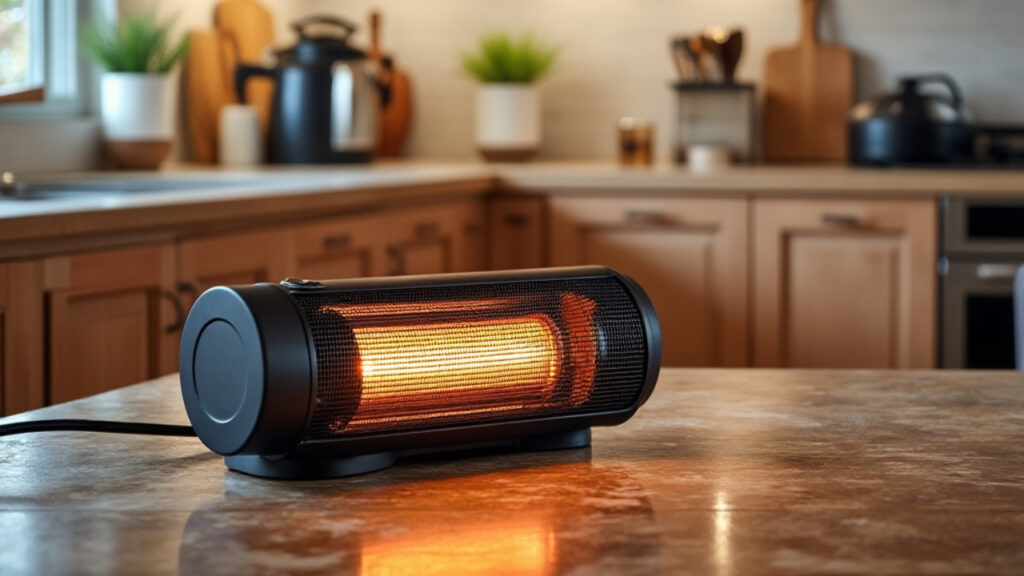
The strongest use case is a room occupied for a predictable period while the rest of the home can remain safely cooler. A home office may fit that pattern. Keep enough background heat for other occupants, pets, moisture control, and plumbing protection. Do not shut off central heating indiscriminately or close a collection of supply vents without understanding how that affects the system.
Deal with simple sources of discomfort first. A draft at a window or a chair positioned near an exterior door can make you raise the thermostat unnecessarily. Appropriate weather sealing and a more comfortable working position may reduce the heat you need. Close the room’s door when that is suitable for the home’s ventilation and heating arrangement, rather than trying to warm an adjoining hallway as well.
Use a modest temperature target and turn the heater off when the room is no longer occupied. A timer can help end a planned session, but does not make unattended operation acceptable. Supplemental heating should follow the person and the activity, with the appliance switched off and cooled before moving. It should not become another background load running all day by habit.
Choose Controls Before Paying for Efficiency Claims
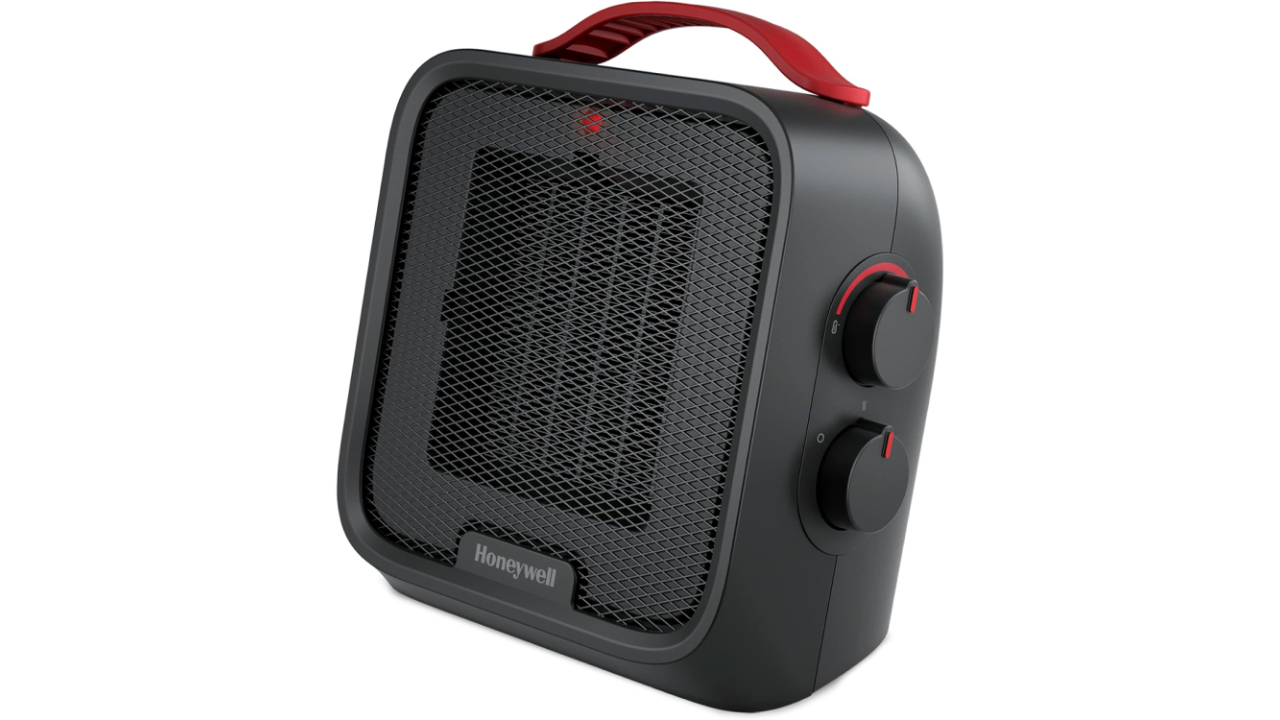
For a simple workspace, a thermostat and a reduced-output setting may be enough. The Amazon Basics oscillating heater offers a moving air stream, while the Honeywell UberHeat 5 provides fixed-direction personal warmth. A remote or digital display can make adjustments easier, but neither changes the basic cost of producing resistance heat.
Other features serve separate purposes. Air purification may be useful enough to justify the Dyson’s price and replacement filters, but those are air-quality benefits, not proof of cheaper heating. The best space heaters comparison separates these roles so you can match the purchase to the job. Include the initial price in your space heater savings calculation if reducing costs is the main reason for buying.
Keep Safety Ahead of the Savings Target
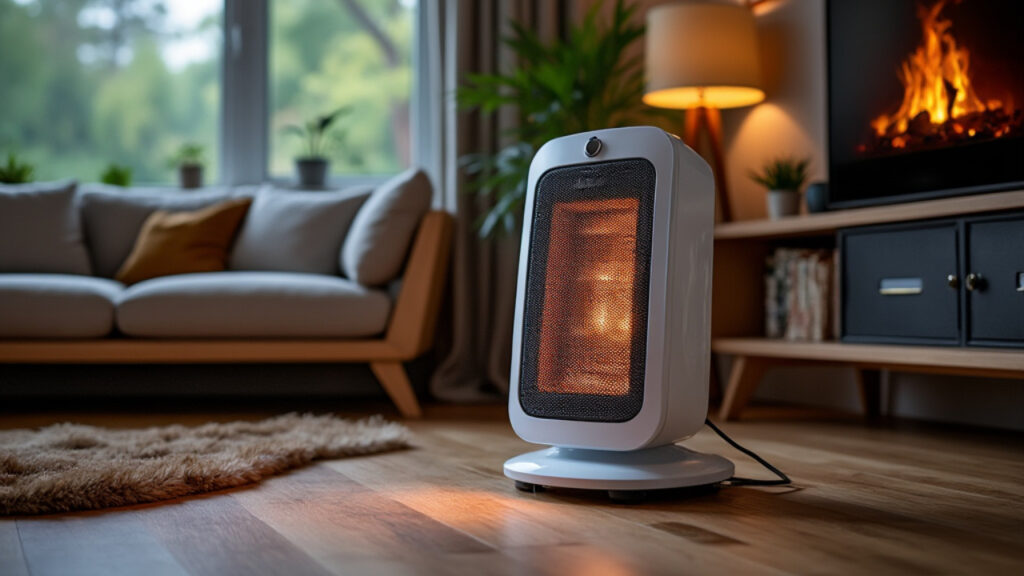
Plug a portable heater directly into a suitable wall outlet. Do not use an extension cord or power strip, and avoid adding other heavy loads to the same circuit. A frequently tripping breaker or an overheating outlet needs attention; it is not a problem to work around with another adapter. Keep the heater stable, its airflow unobstructed, and combustible materials at least three feet away.
Turn it off before leaving the room or going to sleep, and follow the manufacturer’s instructions for cleaning and use. Tip-over and overheat protection are valuable backups, but they cannot supervise the room for you. A plan that depends on unattended overnight heating is not a sensible space heater savings strategy.
Measure the Result Before Calling It a Saving
Estimate the heater’s added cost, make a modest and safe change to central-heating demand, and track use over comparable conditions. Keep the routine only if it improves comfort at a cost you consider worthwhile. A space heater may save money, but a warmer chair alone is not evidence of a smaller bill. The savings come from the heating you no longer need elsewhere.