
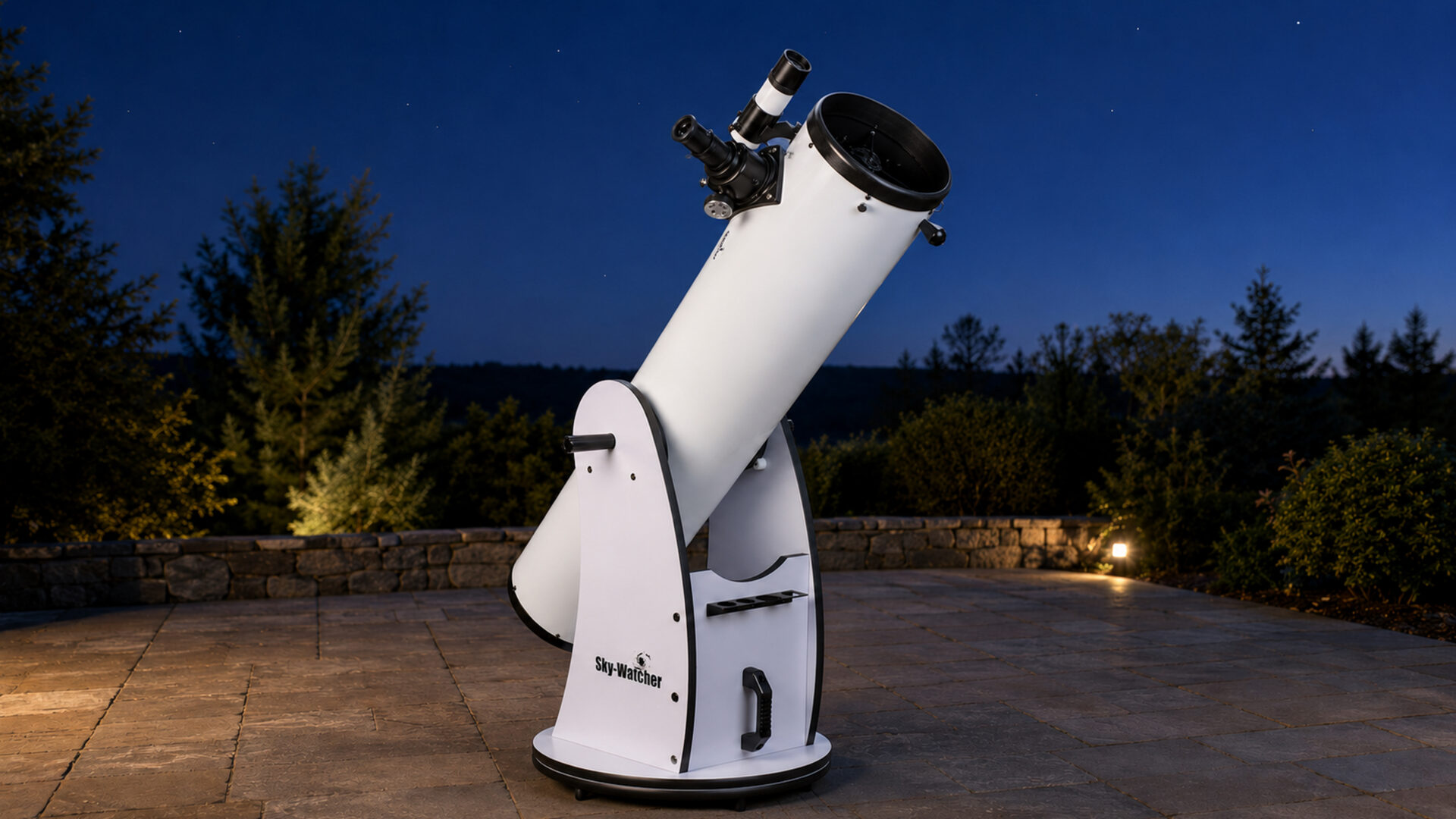
Sky-Watcher Classic 200P Review: Aperture First
The Sky-Watcher Classic 200P Dobsonian Telescope puts an 8-inch parabolic mirror on a straightforward manual base. That pairing remains one of astronomy’s most productive value formulas. It is ideal for visual observers who would rather spend on aperture than electronics and have room for a solid tube, but it asks them to learn collimation, find targets and keep nudging the sky by hand.
Pros
- The 200mm parabolic mirror offers strong visual performance for the price.
- The rocker base is intuitive and stable without motors, batteries or alignment menus.
- A 1200mm focal length works well for lunar, planetary and many deep-sky targets.
- The 2-inch Crayford focuser supports wider-field eyepieces and 1.25-inch accessories.
Cons
- The solid tube and large rocker box require meaningful storage and transport space.
- Manual tracking requires frequent nudges at high magnification.
- The primary mirror needs occasional collimation and time to cool outdoors.
- The included finder and eyepieces are functional starting points, not final accessories.
Eight Inches Put Visual Detail First
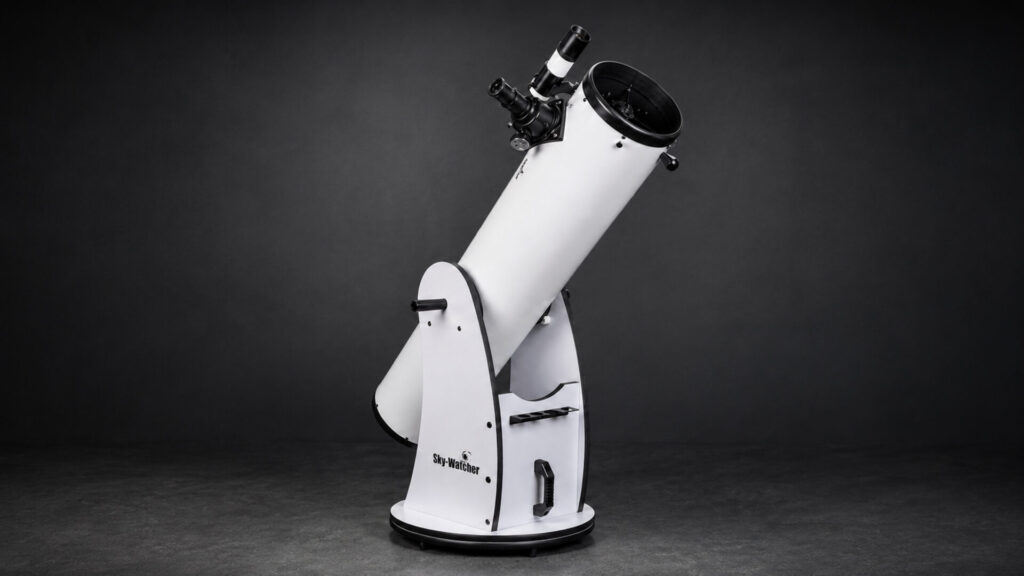
The Classic 200P uses a 200mm parabolic primary mirror with a 1200mm focal length, producing an f/5.9 optical system. At 200mm, the mirror gathers roughly 78 percent more light than a 150mm instrument, which is enough of a step to change how globular clusters, nebulae and galaxies appear under a dark sky. The Moon and planets also benefit from the mirror’s resolving ability when atmospheric steadiness cooperates.
The focal ratio is forgiving enough to work with many reasonably priced eyepieces, while the 1200mm focal length produces useful planetary magnification without extremely short glass. The included 25mm and 10mm eyepieces produce approximately 48x and 120x. Those are sensible starting points. A later medium-power eyepiece can bridge the gap, and a carefully chosen wide-field 2-inch eyepiece can make sweeping larger regions more immersive.
A Dobsonian directs money toward the mirror because the base is mechanically simple. There is no GoTo database, motor or precision equatorial drive sharing the budget. That is why the 200P competes visually with more expensive computerized packages. The trade is equally clear: every target must be found and followed by the observer, so the telescope develops sky knowledge instead of replacing it.
Point, Nudge and Learn the Sky
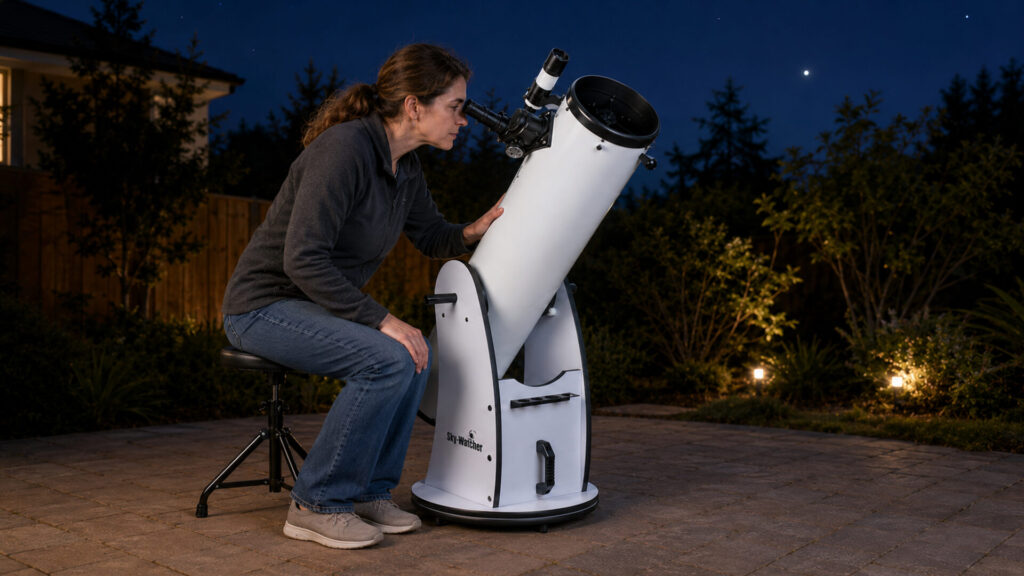
The rocker box turns horizontally on low-friction pads, while the optical tube pivots in altitude bearings. A tension handle adjusts how firmly the tube holds its position as eyepieces change. The movement is easy to understand at first touch, and a seated observer can guide the telescope with one hand while looking through the eyepiece. A stable base also makes focusing less frustrating than on many inexpensive tripods.
At low power, a target drifts slowly enough to enjoy before another small nudge. At high planetary magnification, the field moves faster and requires more frequent correction. That rhythm becomes natural with practice, but it is not tracking. Sharing the view with several people can be less seamless because each person may arrive after the object has moved, while the computerized Celestron NexStar 8SE can keep an aligned target centered.
The included 9×50 finder handles basic navigation. Learn to align it on a distant terrestrial object in daylight, well away from the Sun, then confirm it on a bright star. A phone app or paper atlas can guide star hops from visible landmarks to fainter objects. The skill takes longer than selecting a name from a menu, but it remains useful with every manual telescope that follows.
Collimation and Accessories Are Part of Ownership
Newtonian reflectors need their primary and secondary mirrors aligned so light reaches the focuser correctly. Shipping and transport can disturb that alignment, making collimation a normal maintenance task rather than evidence of a defective telescope. A simple collimation cap or suitable laser can help, though a laser must itself be aligned. The process feels technical the first time and routine after the geometry becomes familiar.
The large primary mirror also needs time to approach outdoor temperature. Warm glass in cool air creates moving currents inside the tube that soften fine detail. Set the telescope outside securely before a serious planetary session, with covers removed only when conditions are safe. Dew, dust and fingerprints should be managed gently; mirrors do not need frequent cleaning simply because a flashlight reveals particles.
Included accessories get the telescope working, but they should be evaluated after several nights rather than replaced immediately. The 25mm and 10mm eyepieces show different useful scales. The straight-through finder can place the observer in awkward positions near the zenith, so a right-angle finder or reflex sight may become the first ergonomic upgrade. Buy around a demonstrated frustration, not a generic accessory checklist.
Make Room for the Tube and Rocker Box
The solid tube is close to four feet long, and the base occupies a broad floor footprint. The pieces separate for carrying, but neither becomes small. A ground-floor closet near the exit can make the telescope feel effortless, while narrow stairs and a distant storage room can quietly end weeknight observing. Measure the path to the yard or vehicle, not only the corner where the telescope will stand.
The particleboard rocker box should be kept dry. Damp grass, dew and long-term garage humidity are harder on the base than on a metal tripod. A mat can separate it from wet ground, and drying the exterior before storage protects both motion and finish. Transport the optical tube so it cannot roll, strike the focuser or place pressure on the mirror cell.
This is primarily a visual instrument. Phones and planetary cameras can record the Moon or bright planets with patience, but the manual alt-azimuth base cannot provide the precise long-exposure tracking required for deep-sky imaging. The telescope should be chosen because looking through it is the goal. If building image files is the goal, the mount belongs at the center of the budget instead.
Should You Buy the Sky-Watcher Classic 200P Dobsonian Telescope?
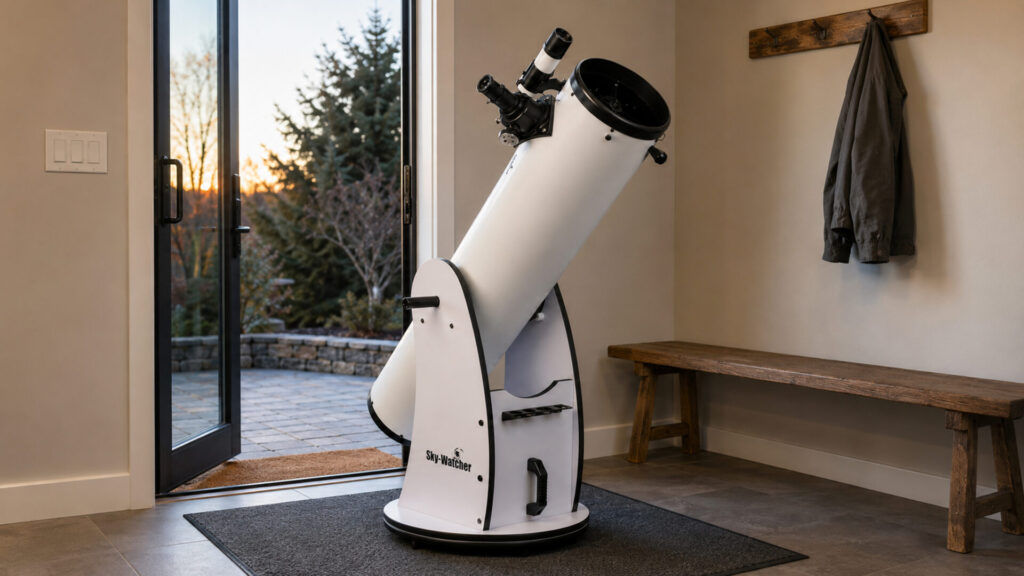
Buy the Classic 200P if visual observing is the priority and you can store and move a solid 8-inch tube. It offers enough aperture for years of lunar, planetary and deep-sky exploration without tying the experience to batteries, menus or software.
Pass if you need automatic tracking, very compact storage or an easy long-exposure imaging platform. A smaller refractor may be used more often from a balcony, and a computerized telescope may be easier for group viewing. The value disappears if the tube is too awkward to reach the sky.
For observers ready to learn the sky and guide the view themselves, the Sky-Watcher Classic 200P Dobsonian Telescope is the strongest visual value in the group.