
Celestron NexStar 8SE Review: Guided Views With Reach
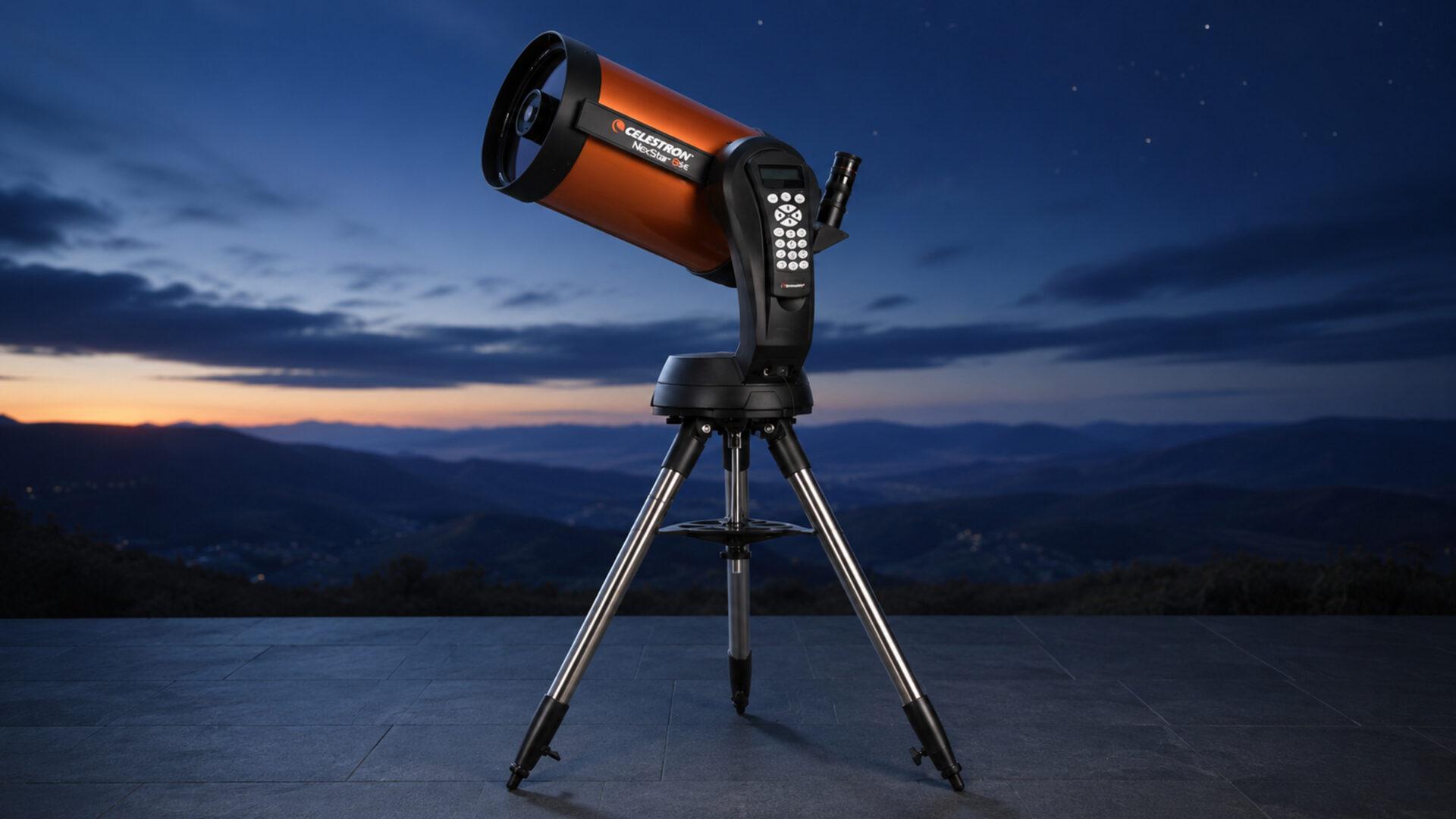
The Celestron NexStar 8SE Computerized Telescope pairs serious 8-inch light gathering with GoTo navigation in a tube short enough for many homes. It is a compelling choice for observers who want rich lunar and planetary detail, access to brighter deep-sky objects and help finding targets, but who understand that alignment, external power and a somewhat lively single-fork mount remain part of the experience.
Pros
- Eight inches of aperture supports detailed visual observing across many target types.
- SkyAlign and a database of more than 40,000 objects assist navigation and tracking.
- The 17-inch Schmidt-Cassegrain tube stores more easily than long reflectors of similar aperture.
- The optical tube can produce strong lunar and planetary images with a suitable camera.
Cons
- The single-fork mount can vibrate during focusing and in windy conditions.
- Eight AA batteries are better treated as backup than the primary power plan.
- The f/10 optical system has a relatively narrow field for very large targets.
- The alt-azimuth mount limits long-exposure deep-sky astrophotography.
An Eight-Inch View in a Compact Tube
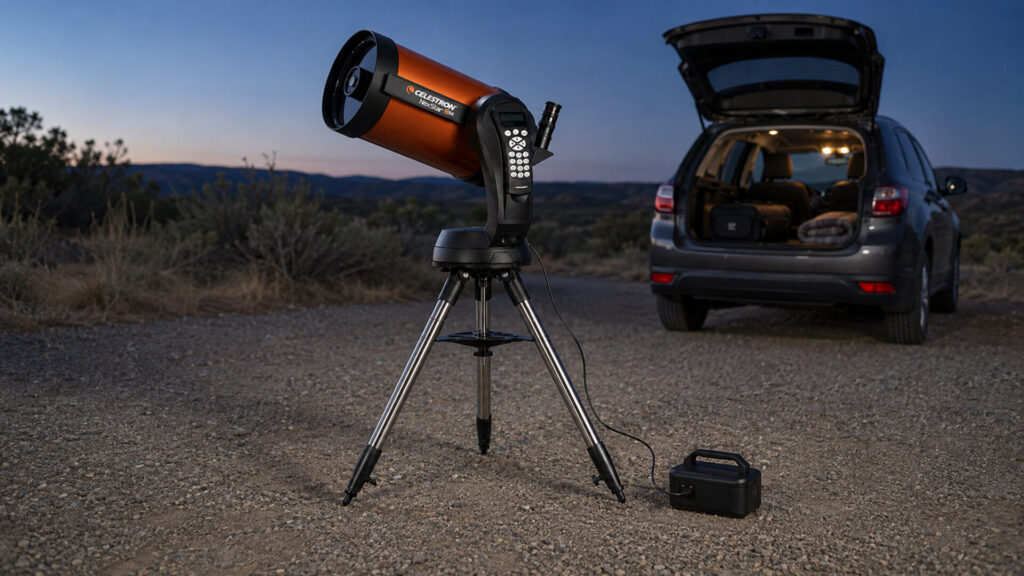
The 203.2mm Schmidt-Cassegrain optical tube folds a 2032mm focal length into a body only about 17 inches long. That combination is the central appeal. The aperture gathers enough light for the cloud belts and major moons of Jupiter, Saturn’s rings, lunar rilles and crater walls, double stars, globular clusters and many brighter nebulae and galaxies. Dark skies still determine how much contrast faint objects reveal, but the telescope gives an observer meaningful room to grow.
At f/10, the telescope naturally produces moderate to high magnification with ordinary eyepieces. The included 25mm Plossl yields about 81x, a sensible starting view for the Moon, planets and many compact deep-sky targets. A lower-power eyepiece can widen the field, but the design will never frame enormous sky regions like a short refractor. Large objects such as the Pleiades can feel constrained even when the optics are behaving perfectly.
Celestron applies StarBright XLT coatings to improve light transmission, and a removable secondary-mirror assembly supports compatible Fastar or HyperStar equipment. That upgrade path can turn the optical tube into a much faster imaging system, though the added camera system and setup cost are substantial. For most owners, the immediate strength remains visual observing through a familiar 1.25-inch diagonal.
GoTo Helps After You Learn the Alignment
The NexStar hand controller offers more than 40,000 cataloged objects and uses SkyAlign to establish the telescope’s position from three bright sky objects. Once the tripod is level, location and time are correct, and the chosen stars are centered accurately, GoTo can place targets near the eyepiece and track them as Earth turns. That is genuinely helpful in a light-polluted yard where star hopping can be difficult.
Computerized does not mean self-setting. The mount still needs a careful physical setup and a repeatable alignment routine. Using a low-power eyepiece to approach an alignment star, then finishing with a higher-power view or careful defocus, can improve centering. Backlash in the drive and a loose tripod can reduce accuracy, so patience during the first few sessions pays more than racing through the hand-controller prompts.
A red-dot StarPointer finder helps place bright alignment stars in the optical field. It is adequate for setup, although some users eventually add a right-angle finder or other aid. Firmware, menus and cables also feel more like operating equipment than pushing a manual Dobsonian. Buyers who enjoy learning systems may appreciate that structure. Anyone who wants to carry a telescope outside and point immediately should compare the simpler Sky-Watcher Classic 200P.
Power and Portability Need a Plan
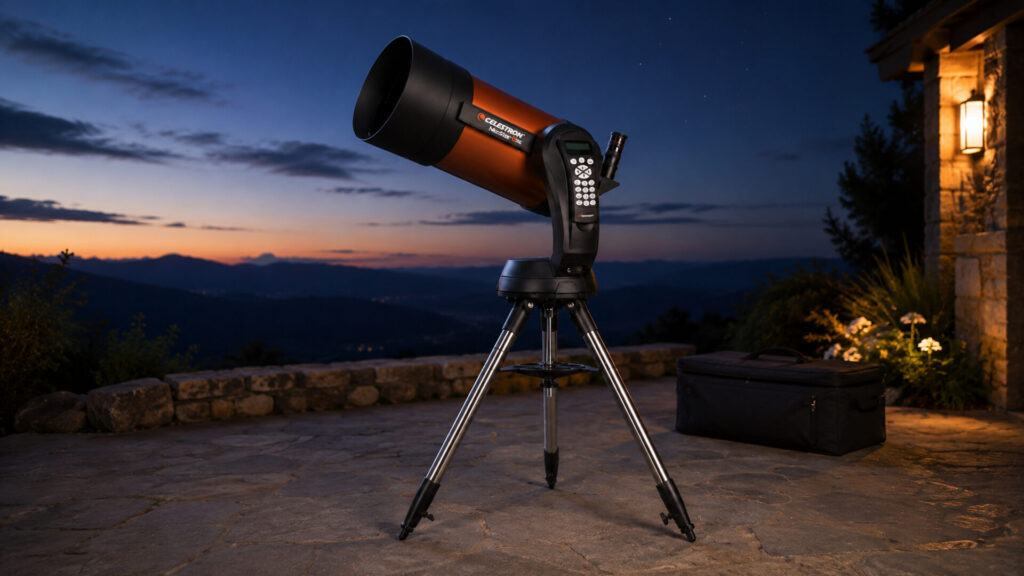
The mount accepts eight AA batteries, but sustained slewing and tracking can drain disposable cells quickly. A regulated 12V supply rated for the telescope is the more sensible home setup, while a compatible rechargeable field battery supports darker sites. Secure the cable so it cannot wrap around the mount or pull free during a slew, and keep an AA set available for short backup use rather than treating it as the normal fuel tank.
Compact describes the optical layout, not the entire burden. The optical tube weighs about 12 pounds, while the fully assembled setup comes in around 32 pounds. The tube and fork arm can be carried separately from the tripod, but stairs and long walks still require planning. A padded case protects the corrector plate and makes the short tube easier to manage without implying that an 8-inch system has become featherweight.
Schmidt-Cassegrain telescopes also benefit from temperature equalization. Bringing a warm tube into cool night air can produce soft, restless images until internal air settles. Set the telescope outside safely before observing, use a dew shield where moisture is common and never point the uncovered corrector at the Sun. Storage should protect the front plate from impact and dust without trapping moisture.
Strong Visual Scope, Selective Imaging Tool
The long focal length makes the 8SE a natural platform for lunar and planetary imaging. A small high-frame-rate camera can record many short exposures, and software can combine the sharpest frames. The mount only needs to keep the target on the sensor for these brief captures, so field rotation is much less restrictive than it is during multi-minute exposures. Focus vibration can be reduced with patience, a motorized focuser or a careful touch.
Long-exposure deep-sky imaging is a different project. Because the stock mount tracks in altitude and azimuth, the sky rotates relative to the camera during long exposures. A wedge can change the geometry, and HyperStar can shorten exposure requirements, but the single-fork mount, clearance near the base and the learning curve keep this from being the simplest first deep-sky rig. An equatorial mount and dedicated refractor such as the Askar 60F form a cleaner starting architecture.
For visual use, mount movement is the more immediate limitation. The tripod and single arm can show a brief shake after focusing, especially at high power. Extend the legs only as far as needed, tighten the spreader and avoid windy exposed ground. A vibration that settles quickly is manageable; an overloaded accessory stack or loose connection that never settles deserves correction.
Should You Buy the Celestron NexStar 8SE Computerized Telescope?
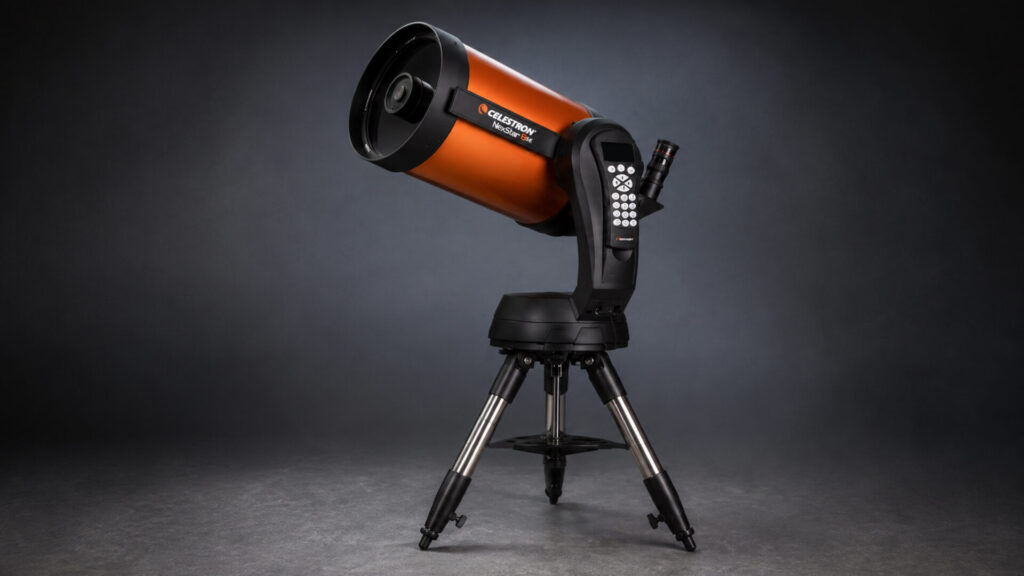
Buy the NexStar 8SE when you want an 8-inch visual telescope that can locate and track objects without requiring a long solid tube. It rewards observers who will learn alignment, provide dependable power and accept a slightly active mount in exchange for compact optics and substantial reach.
Choose a manual Dobsonian if aperture per dollar and mechanical simplicity are more important. Choose a small refractor on an equatorial mount if deep-sky imaging is the primary purpose. The 8SE can participate in both worlds, but its most convincing role is guided visual observing with occasional planetary capture.
For that combination of optical capability and navigational help, the Celestron NexStar 8SE Computerized Telescope remains the best overall telescope in this lineup.