
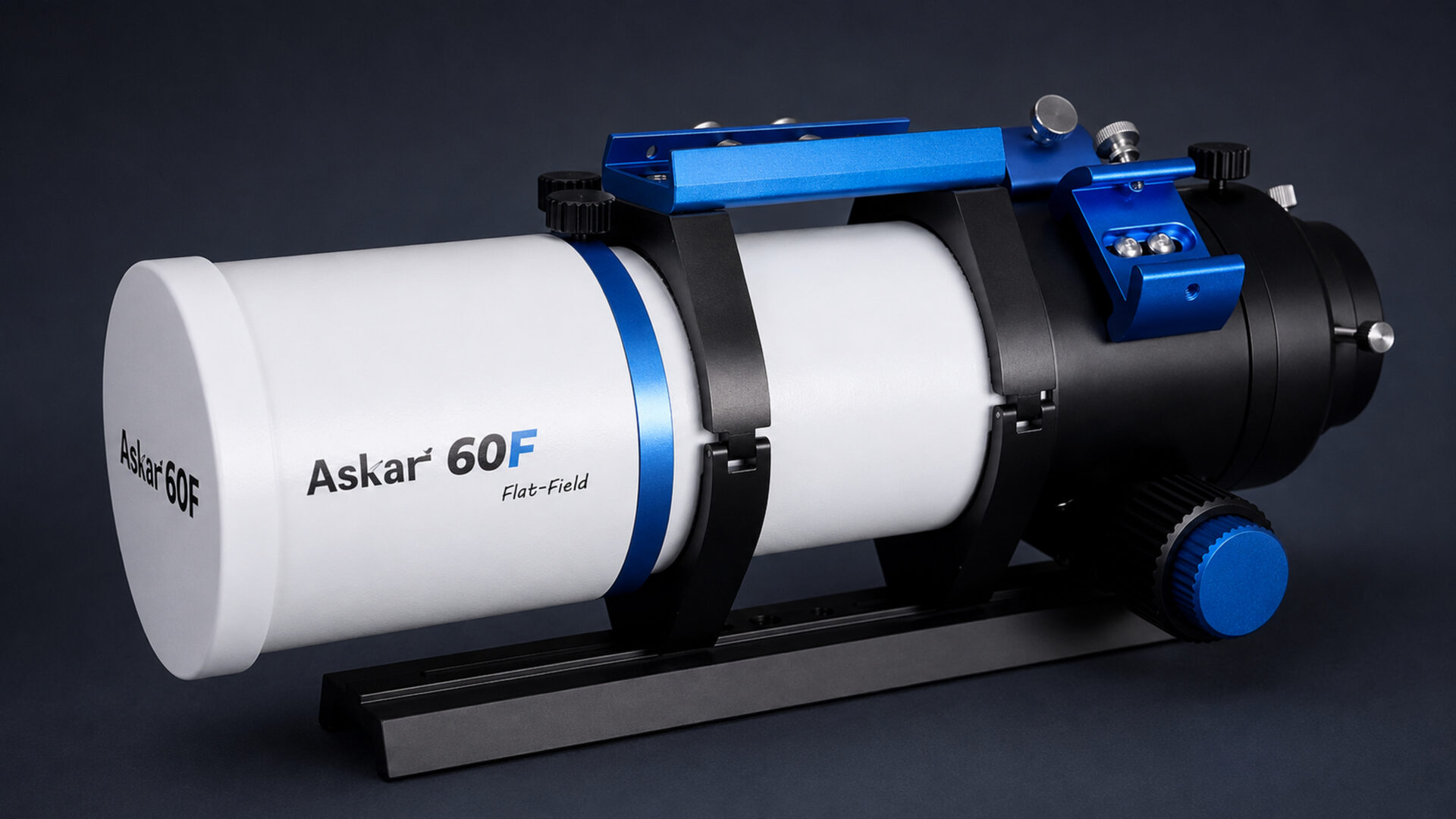
Askar 60F Review: A Portable Imaging Specialist
The Askar 60F Flat-Field Refractor builds a field flattener into a compact 60mm quadruplet, trimming one variable from a portable astrophotography rig. It should appeal to imagers who want a full-frame 44mm image circle, 408mm focal length and serious mechanical controls in a small tube, but it is an optical-tube purchase that still needs a mount, camera and the rest of a carefully matched system.
Pros
- The four-element design includes ED glass and an integrated field flattener.
- A 44mm image circle is designed for full-frame sensor coverage.
- The dual-speed rack-and-pinion focuser includes a rotator and useful threaded adapters.
- The short tube and Vixen-style dovetail suit portable imaging mounts.
Cons
- This is not a complete visual or imaging kit.
- The f/6.8 focal ratio is slower than many dedicated wide-field astrographs.
- A 408mm focal length can feel narrow on smaller sensors for the largest targets.
- As a newer model, it has less long-term independent evidence than established alternatives.
A Flat Field Without Another Corrector
The 60F uses four air-spaced lens elements, including one extra-low-dispersion element, and incorporates field correction into the optical design. In a conventional refractor, stars near the edge of a flat camera sensor can fall out of focus because the telescope naturally forms a curved image. A separate flattener corrects that geometry but introduces another spacing specification. Askar’s design aims to deliver the corrected field at focus without a separate backfocus calculation.
The 44mm image circle is wide enough to cover a full-frame sensor diagonally. That does not guarantee every camera will show identical corners, because tilt, filters, adapters, focus and sample alignment still affect results. It does establish the intended format and distinguishes the telescope from small refractors designed only around cropped sensors. Critical buyers should examine full-resolution stars from their planned sensor size rather than judging compressed promotional examples.
At 60mm, the aperture is modest. Astrophotography can integrate light across many exposures, so the smaller lens is not a barrier in the same way it would be for visual deep-sky observing. The compact front element also places less demand on a portable mount. The design is best understood as a camera lens built around astronomical focus and mounting needs, not as a tiny substitute for the visual reach of an 8-inch reflector.
A 408mm Focal Length Chooses Its Targets
The 408mm focal length frames many nebulae, larger galaxies and star fields well on a full-frame camera. Sensor size changes the composition: an APS-C or Micro Four Thirds camera crops the field and makes the same telescope behave more tightly. Use a field-of-view calculator with the exact camera and target before assuming the word wide-field describes every pairing.
At f/6.8, the 60F is not especially fast beside f/4 and f/5 astrographs. Reaching the same signal can require longer total exposure time, which raises the importance of tracking, guiding and clear hours. The moderate focal ratio can be easier on filters and focus than an extremely fast system, but it should be selected deliberately rather than mistaken for a speed-focused design.
The scale is also not intended for small planets. Jupiter and Saturn occupy few pixels at 408mm without amplification, and the 60mm aperture limits fine resolution. A long focal-length telescope such as the Celestron NexStar 8SE is a more natural planetary platform. The Askar is at home when the target has shape across a generous patch of sky.
Build the Rest of the Imaging Rig
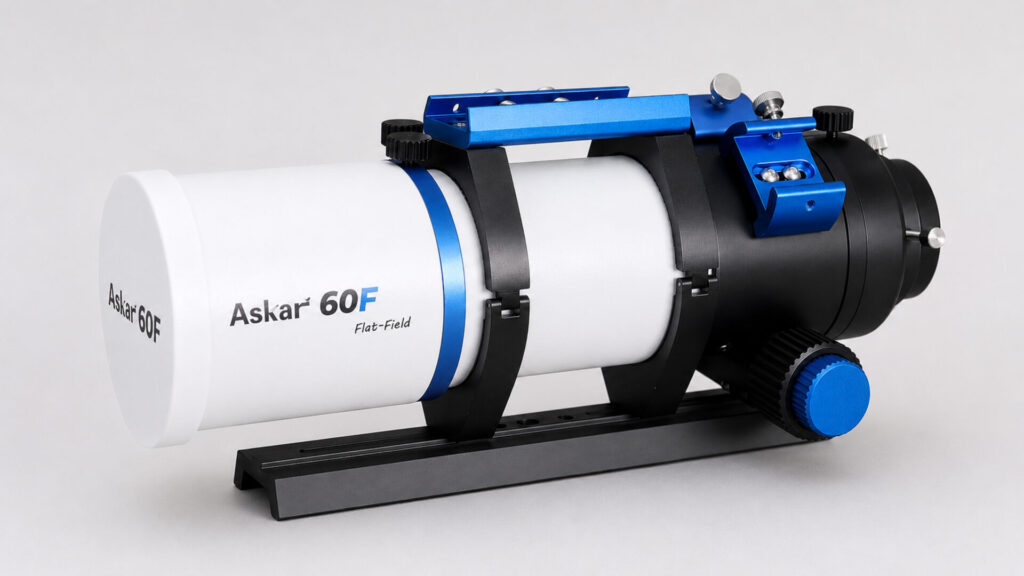
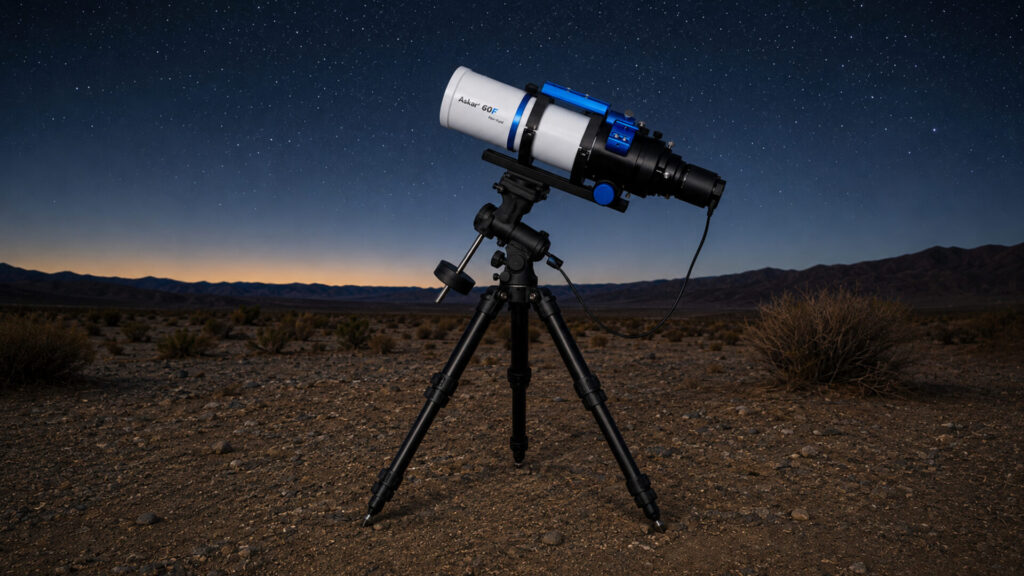
The box includes the optical tube, rings, a handle, a 230mm Vixen-style dovetail and photographic extension hardware. It does not include an equatorial mount, tripod, camera, guide system, controller, dew management, power supply or visual eyepiece package. The telescope can be the smaller portion of the finished system’s cost. Begin with payload, tracking goals and camera compatibility before treating the tube price as the project budget.
A 2.4-inch rack-and-pinion focuser provides 50mm of travel and a 1:10 fine-focus control. Fine reduction is valuable because small temperature changes can shift focus enough to enlarge stars. The 360-degree rotator helps compose a target without loosening the entire imaging train, while M48 and M54 connections offer threaded routes to common camera adapters. Every threaded joint should seat squarely without excessive force.
Cable routing deserves attention on a compact rig. Camera power, data, dew-heater and guide cables need enough movement for the mount but should not drag across the focuser or pull during a meridian flip. The handle can support accessory mounting if weight and balance remain appropriate. A neat-looking rig is useful only when it stays balanced throughout the night.
Portable Tube, Serious Mechanical Details
The optical assembly weighs about 2.36kg, or roughly 2.86kg with rings and dovetail. Accessories quickly add mass, but the starting load is friendly to many compact equatorial mounts. The retractable dew shield and tube length of roughly 289mm in its shorter photographic configuration make it a realistic travel instrument rather than merely a small-aperture one.
The mechanical package includes a long dovetail that helps balance cameras of different weights, tube rings, a top handle and a rotator with engraved markings. These are not glamorous specifications, yet they determine whether framing and balance can be repeated after transport. Check that the chosen mount accepts the Vixen-style plate and that the saddle grips it securely along a useful length.
A visual adapter supports 1.25-inch and 2-inch accessories, but a diagonal and eyepieces remain separate. Visual use can provide attractive wide views, though the small aperture and imaging-first price make it a specialized way to reach them. Readers who mainly want to look through a refractor should compare the larger, simpler Celestron AstroMaster 102AZ before funding an imaging-grade tube.
Should You Buy the Askar 60F Flat-Field Refractor?
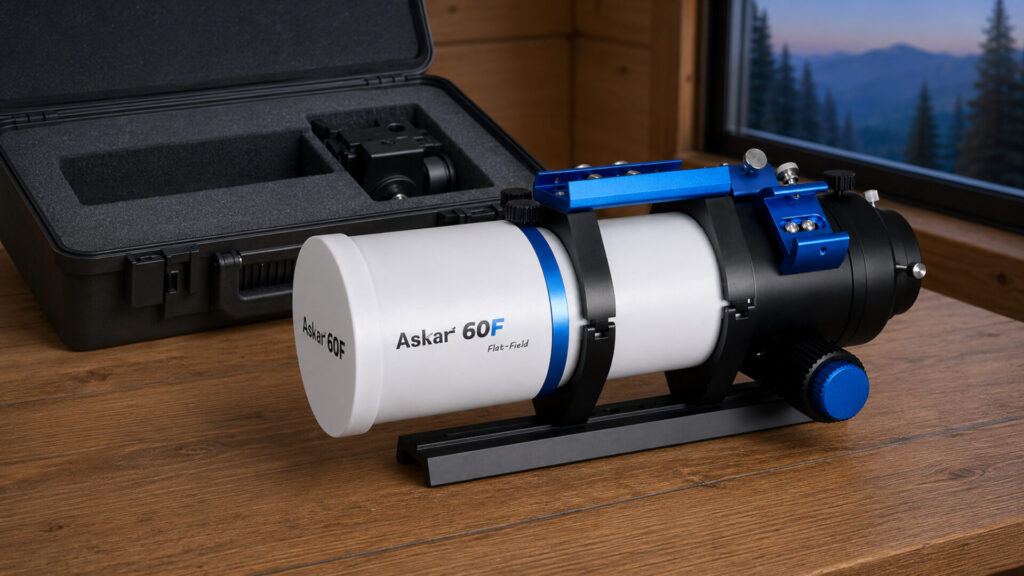
Buy the Askar 60F when a compact full-frame imaging refractor fits a planned rig and the built-in flattener removes a spacing problem you would otherwise need to solve. Its mechanical controls and portable size are as important as the optical prescription.
Do not buy it as a complete beginner telescope. The tube arrives without the mount, camera and operating system that make long-exposure astrophotography possible. Imagers seeking a faster focal ratio or a much broader field on a crop sensor should model those alternatives before committing.
For a deliberate 408mm camera system that values portability and a simplified corrected field, the Askar 60F Flat-Field Refractor is the lineup’s strongest astrophotography choice.